Showing posts with label Singer 128. Show all posts

Thursday, March 16, 2023

Petticoats and possibilities - my quest for a capsule wardrobe continues

 Layers!

Hens are great layers.  But even better are clothes layered on top of each other.  It transforms a seasonal outfit into a multi-season extravaganza!  

Winters on the farm are muddy, mucky, bloody, and occasionally snowy.  I do a lot of laundry.  

Come lambing season, I can do two or three loads of laundry a day.  

So I want farm clothes that wash well, like cotton.  Only the problem with cotton is that it's not very warm.  It actually, what's the opposite of warm?  A single layer of cotton is terrible for working outside in the winter because if the cotton gets wet, it chills the human and can cause health issues.  So we could be forgiven for thinking that if a single layer does harm, a lot would do more.  

Layering the clothes creates air gaps that allow the skin to breathe and provide insulation so I can stay outside longer to get things done.  And since I often wear skirts or dresses when working on the farm, I can take my fall and spring cotton skirts and transform them into winter skirts by adding a petticoat or two underneath.  


This matches well with my capsule wardrobe goals. 


Saturday, September 04, 2021

Sewing - the narrow hemmer foot

This last year I've been learning a lot about sewing.

It turns out it takes less time and money to sew my own clothes than it does to try to find something that fits both my style and body.  But sewing means I can make what I want to wear and make it fit.

I do my sewing on my Antique Singer 127 (which is now about 105 years old!).  It's such a kind machine and forgiving.  

One of my favourite feet is the narrow hemmer foot.  It's a bit tricky to use until you figure out that the fabric edge lines up with the edge of the foot before folding over.  Hard to explain, so I made a video:


If you like this sort of thing and want to see more of it, here are some things you can do to support me on my youtube journey.

- go to youtube and give me a thumbs up!  Or even a subscribe!  That would be awesome
- or pop over to my Etsy shop and support me that way.

Tuesday, April 17, 2012

Singer 128 - How to use the vintage buttonholer (it makes button holes so you don't have to)

I don't know if this might help or interest anyone out there, but I'm putting together a series of Getting to Know my Antique/Vintage Singer Sewing Machine. Today I learnt about The buttonhole attachment.

I would like to ask any sewing machine experts to please point out anything I'm doing wrong. I'm a self taught sewer and am learning about the machine by working my way through the manual.


This is a Singer 128 hand crank sewing machine.


It's a nice little portable machine and takes the same bobbins and shuttle as my Singer 127.

I need to make some button holes, and just in case you didn't know yet, these vintage machines don't do a zig-zag stitch.  Gasp!  Whatever will I do?

Never fear, I have an attachment for that!

Vintage Sewing Machine Buttonholer attachment

The buttonholer, or button hole attachment is a marvellous thing.  It works on almost any of the old straight stitch vintage machines with a low shaft foot.  I think you can get a high shaft one, but I have yet to see it.

Very First thing to do is to check your thread tension.

The first second thing you need to do in order to use the buttonholer is to cover the feed dogs.  They are the teeth that move the fabric along while you sew.  The instructions are to use this little plate that comes with the buttonholer to cover the feed dogs.  It just floats over top of them so that they don't get damaged.
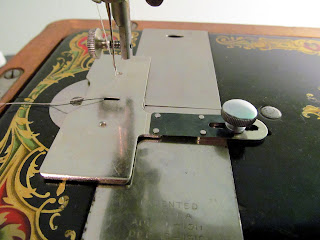
Vintage Buttonholer feed dog cover


If you don't have a plate like this, another option would be to remove the feed dogs temporarily while you use the attachment.  You need a screwdriver and to get underneath the machine.  I haven't tried this yet, but I'm told it's fairly easy as feed dogs often need to be replaced over the years.

Next you set up the buttonholer with the right size cam.  There are a bunch of different size templates that can go inside the buttonholer to make different size button holes.

Vintage buttonholer attachment cams

upside-down buttonholer
Now for the real tricky part, attaching the buttonholer to the machine.  There is an arm that needs to go over the screw that holds the needle in place.


And a bar that attaches to the pressure foot vertical-up-down-thing-I-can't-remember-what-it's-called-right-now.


Insert the fabric between the feed dog cover plate and the buttonholer.  Lower pressure foot.  Sew as usual.  In theory the buttonholer will hold the fabric for you and move it as needed, so all you need to do is make certain the thread does not tangle, the machine moves at an even pace and the weight of the fabric does not pull at the sewing.

Not so sure about this 'add caption' option, what do you think, is it helping?

buttonholer in action
 The thing I don't like about this attachment is that if you want to change the size of the button hole, you have to take the entire thing off the machine, change the cam, put it back on again.  The manual suggests that you make a test strip of all the different sizes.  I might just do that when I get a chance.


Buttons are happy, the hole fits!


Sunday, April 01, 2012

A rusted sewing machine, mystery steampunk project and playing with my typewriter


Found some neat stuff at yardsales yesterday. Among them yet another Singer 127 sewing machine on a treadle base for next to nothing. Problem is, it's in absolutely rotten shape. Everything's rusted, including the treadle base. However, it does have some parts on it that I can use to repair this 128 I have hanging around. Perhaps the left over parts could be used for art part of my mystery project? What do you think? Do manual sewing machines seem steampunkish to you?


I also found these nifty tags.


Of course, this means that I had to play with my typewriter. But I don't need much excuse for that.