Showing posts with label Knitting Machine. Show all posts

Saturday, May 07, 2022

Knit a sweater in a day, they said! It would be easy, they said! yeh right.

 I think the title says it all really.  

This wonderful machine fell in my lap and in my hubris I thought I knew plenty of knitting and this would be easier than the two pointy sticks.

yah right.


At the end of the sweater, I am overwhelmed by how much love and respect I now have for machine knitting and machine knitters.

It really is true that it doesn't matter what tools we use.  It's what the knitter brings to the yarn that makes all the difference.  

I can't wait to find out how to use my ribber.  Any ideas?  There don't seem to be many tutorials on this that I can find.


(oh, and there is dyeing and sheep in there too because, well, sheep)

Wednesday, September 22, 2021

It goes round and round.

What can I say?  

I had fun at my first fibre festival in almost three years.   

I didn't buy anything in the end, but I got some cute videos of fun stuff.  Including, one of my favourite booths...


Yes, I know.  I really do need to get my knitting machine out and start knitting socks..  I have a few projects to finish first, then socks, here I come.


For this video, I decided to try something new.  Let me know if you like this kind of foolishness and I'll make some more.  


If you like this sort of thing and want to see more of it, here are some things you can do to support me on my creative journey.

- go to youtube and give me a thumbs up!  Or even a subscribe!  That would be awesome
- or pop over to my Etsy shop and support me that way.

Monday, September 14, 2015

cast-on bonnet for auto knitter sock machine


There are some times in life when one simply needs professional help.

About three years ago, when my arthritis finally forced me to stop knitting, I received the  most wonderful machine: An ancient circular sock knitting machine made by Auto Knitter.  I had great fun trying to get it to work, and I was nearly there, but in the end, life happened, and it was time to put the machine away.

Although, to tell you the truth, at the time, I think I had the machine working perfectly, it was simply the user that was broken.

So, for the first time in over a decade, things in my life started to calm down and I was able to take my Auto Knitter to a mentor and see if he could fix it (or the user) so that knitting could happen.  Getting help from someone with loads of experience and enthusiasm for the machine - that was amazing.

I'm very happy to learn that it was mostly user error.  I now know how to do the knit stitch, picot edging, decrease, yarn overs, cast on, cast off, and change yarns.  Yet to learn are turning a heal and the purl stitch, but once I know those I can make just about anything.

To practice my new skills, I have been making cast on bonnets.


It's a funny looking thing, but what it does is provide an easy way to cast on stitches on the knitting machine.  Trust me, it really does.  Maybe I'll show you some time.

This one is for my 80 needle cylinder - see, 8 stripes.  I'll make one for my other cylinders once I have them up and running.


The ultimate goal, once I have the machine running perfectly, is to make socks with yarn I've spun, with wool from my sheep.  Hopefully it doesn't take another three years to get there.

Sunday, January 27, 2013

Vintage Auto Knitter - IT WORKS


Isn't that a beautiful sight?  More later.  Right now I'm busy ;)

Monday, December 03, 2012

Vintage Auto Knitter goes back in the box, for now

I'm putting my Auto Knitter back in the box... for now.


I've almost got it working.  I took out every second hook and threaded it per instructed but alas...


Before putting it in the box I took out all the needles, gave them a generous helping of sewing machine oil, wrapped them in paper towel and stored in an air tight container.  Please Note, oily paper towels and cloth, when exposed to air over time, can spontaneously combust and burn down your house.  Keep them air tight and dispose of them properly when no longer needed.


My next step is to order some new needles.  I think that is where my major problem is at the moment.  Some of the needles are slightly bent and several of them have a latch that does not move smoothly.

  From there I will try again on my own.  When - ops I meant to say if - if that fails, then I will get in touch with one of the lovely mentors who have offered their services, and see if they would like to visit our fair town.  Maybe they could host a Get to Know your Circular Sock Machine and Troubleshooting class?

If anyone is actually interested in a course like that in Victoria, let me know.  I'll see if I can arrange one.  It would probably be late January or Fab.  2013.

Sunday, December 02, 2012

Troubleshooting cast on for my Auto Knitter, vintage sock machine

Now that everything is cleaned and put back together, all that remains is to get this vintage sock knitting machine working.  

I've been reading forms, watching videos (like these ones which are for the modern version of this machine), and asking the good people on Ravelry for advice.  I've come to realize two important things: There are some really brilliant people on the internet, and the minuscule precision needed to make this machine work properly makes everything else I've repaired look like a block of wood.  From sewing machines, power tools, spinning wheels, and all the other mechanical goodies I've worked on aren't anywhere close to what this machine is like to work with.

But lucky for me, the first thing I mentioned: those brilliant people who are willing to talk me through this.


This post is basically a bunch of pictures of things I've tried to make the machine work and a summation of many of the helpful tips I've been given.  It doesn't have a happy ending ... yet.  But I'm not giving up.  


The V-cam:


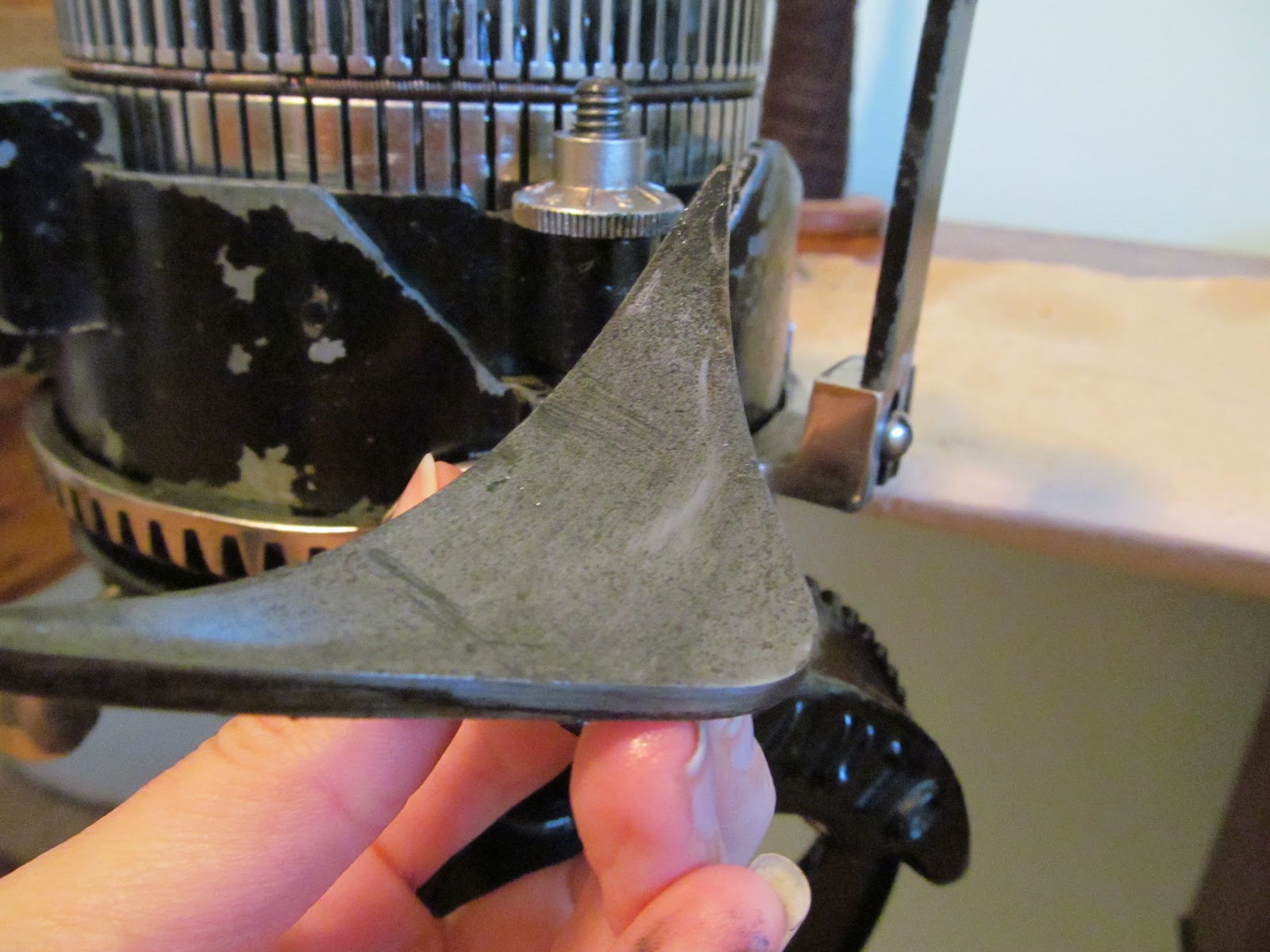
I lowered the V-cam so that it is as low as it can go and not risk jamming.

I also switched the V-cam for the spare that came with the machine.  The one that was in the machine showed signs of wear in one spot where it seems to be rubbing against the cylinder 


The yarn guide:


I moved this closer to the needles so that it is almost but not quite touching.  I also lowered it.


And then I lowered again.  


The yarn:


The yarn needs to feed freely from the source to the machine.  So I took some off the spool and let it lay loose.  Later on, once I've fixed the spool winder, I'll use some cheep sock yarn from my stash and see if this works better.


The weights:


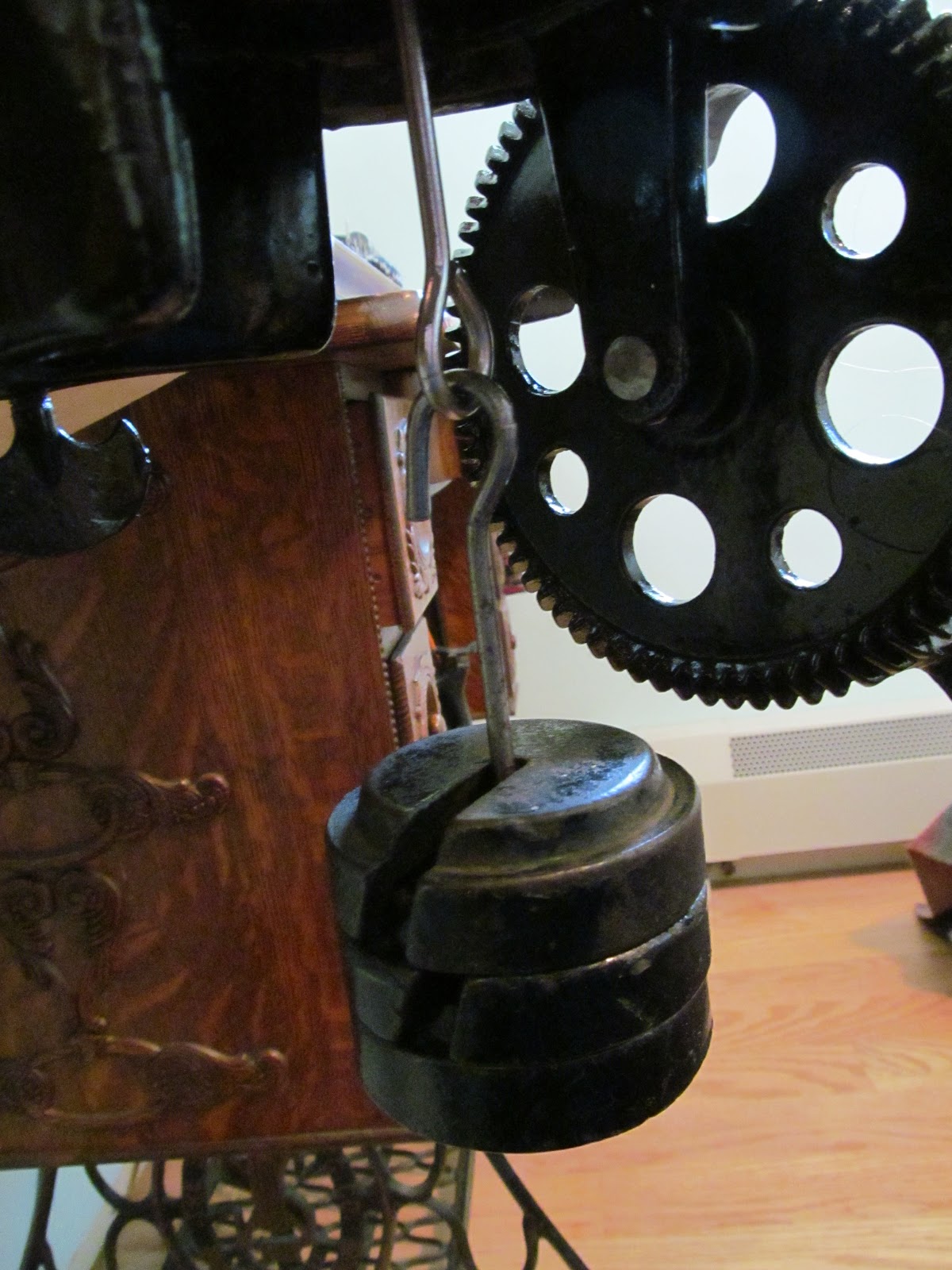
Am I using the proper amount of weight for this task?  I really don't know.  


Apparently the weight is very important for the correct formation of stitches.  Each of these disks weighs about a pound, so I thought I would try three pounds.  Maybe next time I'll put the fourth on and see if that works better.


Casting On:


It's often been said that threading every second needle makes casting on easier.  I think it makes it so the yarn does not get wound too tightly on the needles.  


As you can see, there is still something wrong.


My next steps in the trouble shooting process
  • try a different yarn
  • get new needles - Angora Valley Fibres has them for sale.
  • and as a final effort, find a mentor.  A few people have been in touch, but all of them live out of town.  But I suspect there are enough people in Victoria who are interested in learning about these machines. Some of them even have a machine or two in the basement waiting for guidance.  Maybe some sort of clinic or workshop is in order?

Thursday, November 29, 2012

Auto Knitter Made in Canada

Meet the Auto Knitter, a circular sock knitting machine from 1924.


An early Holiday gift from my father, and one that will put to great use, once I get it up and running.

Machines like this were very popular during and just after the first world war.  A person could buy a machine and a contract to produce socks.  Some companies even gave the machine on condition that the person would produce so many socks for free.  Sadly, many of these did not survive over time, often being melted for ammunition during the second world war.

This machine came with some excellent documentation, including the original contract and bill of sale.  In the year 1924, a Mrs. M. C. Russell of Malrose Ave. South, Hamilton, Ontario paid the sum of $60.85 for 1 duplex machine.  (if you are a descendent of Mrs Russell, feel free to get in touch, I can scan you a copy of the materials that reference her.  There are more details than what I'm posting here.  There is also material referencing a Mrs. W. Wilson of Emerald St. North, Hamilton who was a "successful worker in Hamilton" of the Auto Knitter Hosiery (Canada) Co. LTD.).

A worker, would be required to buy the yarn from the company, 2 and 1/2 lb of yarn making a dozen pairs of socks.  Then the company would buy the finished socks back from the 'knitter'.  Pretty cool cottage industry eh?

the spring holds the needles in place,
and this little bar thing holds the spring out of the way
when you need to work on several needles at once.

This machine is in fair condition.  There is some definite wear marks, but everything is here, including extra cylinders and ribbers.  It had been stored somewhere where it got saw dust on and in it.  Sawdust sticks to machinery like a red wine stain to a white shirt.  Things like sawdust and lint, then attract moisture, and moisture when combined with metal over time causes rust.  Lucky for me it wasn't too bad, but did need everything taken apart  cleaned and re-oiled.  A tedious and time consuming, but the kind of finicky repetitive work I love.

With everything cleaned and reassembled, it's time to cast on some knitting.

weird looking tool for casting on work
The amount of difficulty I've had trying to get the knitting started has helped me to understand why people didn't stop their work very often.  What they did was knit one sock, then a few rounds of waste yarn, then another sock, then some waste yarn... separating the socks at the waste yarn and finishing them by hand.  That way, if done correctly, they would be able to knit for years and never need to cast on.

from the auto knitter manual

from the auto knitter manual


I'm not the only one who has had trouble casting on.  Included in the documentation is a letter from the company providing extra advice.  But even following that advice, I can't get it to work.


I'm either all tangles or braking yarn.

Eventually I'll make it work, or perhaps find a mentor at the local machine knitting guild.  There don't seem to be many tutorials online, so now I have a good idea for a future post.