Sunday, June 10, 2012

Little brass lamp

Yesterday's yardsale finds included a big box full of brass stuff.  At the bottom of the box was this lamp.


A bowl on a stand doesn't look like what we generally think of as a lamp these days, but it's actually quite amazing.  It is a very traditional style (although this one is more ornate and built for the tourist market) and runs off of almost any kind of fuel from old cooking oil to rum.  Vegetable or fish oil is more traditional.  This is very economical as you can save your old cooking fats and use them in this lamp.

I've read about these but I've never seen one used.  Books say that they are very dirty and smelly kind of lamp.    But when I tried it out, it turns out that this is even better than the 'standard' oil lamp that we use during power outages.

Fill the bowl with oil (in my case sunflower oil) and stick a cotton or linen wick in it (some weaving thrums).  Leave the wick in the oil for several hours (the longer the better - but at least 5 hours) to soak up the oil.  Then hang one end of the wick over the edge of the bowl slightly with the other end in the oil.  Light the end of wick that is not in the oil (this takes a few matches on the first go, but gets easier the second time).

Now we have fire!


But, um, we also have smoke!

Don't worry, there is a way to fix that.  Simply get something nonflammable like a knife or sewing pin or whatever, and use it to carefully adjust the length of the wick.  Make sure the wick stays against the side of the bowl. 


Once I get around to polishing up the inside of the lamp bowl, it will reflect more light and make the lamp an even better light source.


When comparing this to the 'standard' oil lamp, it has some considerable advantages.

First off a 'standard' oil lam only works well with lamp oil, an increasingly expensive petrol product.  This traditional oil lamp works with any fuel but best with vegetable oil.  I'm going to give a try of using it with old cooking oils next, as that's what many cultures use to use.

It produces quite a lot of light, maybe four to eight times a single tealight candle does.  This depends on the fuel and the length of the wick.

This brass lamp doesn't produce much heat.  It would be enough heat to say, run a Stirling engine, but not as much heat as a 'standard' oil lamp.  About the same amount of heat as a tealight candle.  After burning it for quite a while, the brass remained cool enough to touch.

Vegetable oil as fuel seems to last long than lamp oil for the volume of the fuel.  


I can see all sorts of uses for this from emergency light to, um, I don't know, a way of fuelling a Steampunk device using reclaimed oils as an environmentally friendly fuel source.


Thursday, June 07, 2012

7 year fleece! or Llama gets a hair cut

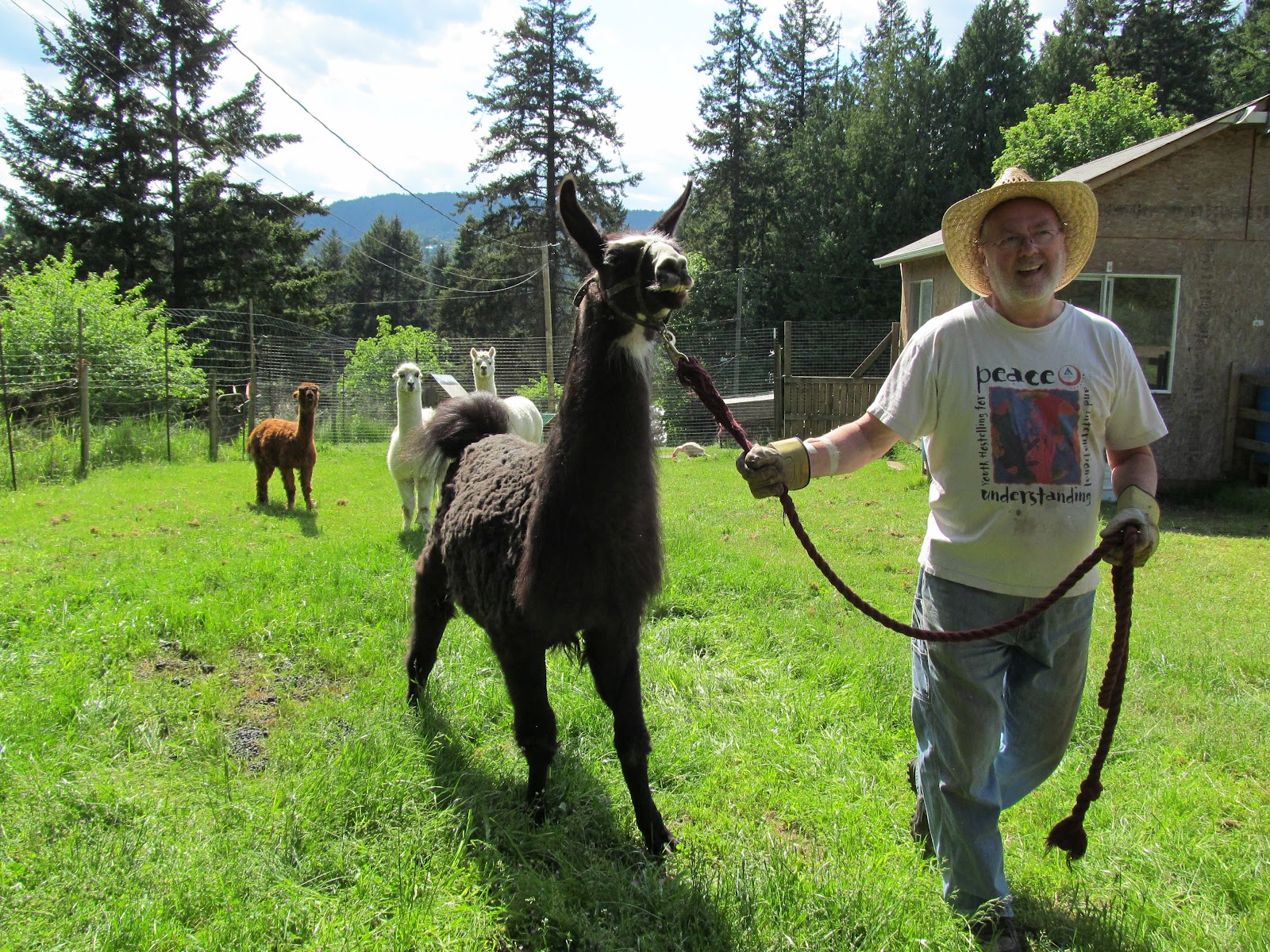
Last summer, a rather harry llama adopted our heard.  He's big and strong and we call him Tom.  Tom belongs to our neighbour who lets our fibre boys graze on the pasture on the hill.  Neigbour said it would be okay to have llama Tom shorn when Rose the Llama Lady was next in town.


Hug the head close to your chest so they can hear your heartbeat and they calm right down.

That's at least seven years of fibre growth on this llama.  As you can see he's a mess.  However, it is unbelievably soft for a llama.  If I can get the veg. matter out of the fibre, this is going to make BEAUTIFUL yarn.


It was so long that he needed to be shorn by hand.

I actually really like hand sheering - perhaps because I'm not the one doing the sheering.  It leaves a raggy looking coat for a few days, but after a week, he looked far better than he would have with the electric sheers.  The animals seem to feel comforted by the hand sheering whereas the machine scares the spit right out of them.


Isn't he a handsome boy?  Not sure who's happier in this photo.  Well, it's not the jealous alpacas in the background, that's for sure.


Feeling mighty handsome, but ready to go eat some grass now thank you.


I have to sort through the fibre and pick out the guard hairs.  The guard hairs are just like human hair, and as long as my arm.


We didn't have our alpacas or llama shorn this year.  They just had a trim.  They were so cold last winter, especially our oldest one Max, who is very old in llama years apparently, that I didn't have the heart to shear them this year.  Llama Lady said it was actually good for the llamas and alpacas to go a year between full sheering so long as they get their under arm hairs trimmed in the spring and we keep an eye on them in hot weather for overheating.  Personally, I'm glad for the longer fibre staple that two year growth provides.  Longer fibre = more fun to spin... at least for me it does.

Wednesday, June 06, 2012

"IT WORKS!" Dances about the farm, in an over enthusiastic manner humming a little song about, "IT WORKS"

I've been tinkering away at my latest slightly steampunk mystery project where I convert an old (non-restoreable) vintage sewing machine into an Other-machine.  Well, last night - rather late last night - finally finished modifying a piece of perspex and put it into place.  I now have a fully functioning other-machine.  Photos to come later, once I've finished decorating it.

Now, how to decorate it?  I still have to install the cooling system.  I'm also thinking of installing a clock (clocks are pretty standard for steampunk) - but I'm tempted to install a radio instead.  I have this gaping hole to fill you see, and adding leavers, nobs, or other decorations that don't do anything doesn't really strike my fancy.


Yes, I know I've been remiss with my blog, my zine, my etsy shop, my online presence in general.  But I figured you didn't want to hear me moping about deaths of Cockylocky and Chicken little, the epic battle of the rose that went on in the household - and still isn't over I think - Talk about projection and deflected anger (some of it mine I'm sure, but from my point of view I care for the roses daily, it wasn't the first bloom or the only blossom on the bush, I just wanted on little flower for my room, there was no need to yell at me... never mind).  And then there is today's battle: trying to teach a professional cleaner how to clean efficiently without chemicals.  A box of borax lasts 8 to 14 months, not 2 hours!  This week, since reading instructions is obviously not working, I've tried repackaging the materials to look more like store bought chemicals and hidden the ingredients for making more.  See how that goes.


For those of you waiting for the next Crowing Hen Guide.  Inspire me!  What do you want to hear about?  Over view of natural cleaning materials and a few recipes for your house?  A treatise on composting?  How to rid your roses of aphids and black spot in under a week WITHOUT using those nasty chemicals?  How to clean and oil a vintage sewing machine?  An in-depth discussion (okay, monologue) on how to clean floors using natural products - many of which are already in your pantry?  

I'm overwhelmed with things I want to write about that I'm having trouble just sitting down and getting started.  I really don't know if anyone's interested in these things.  Am I just writing them to stop bending the ear of every poor chap that chooses our driveway to turn their car around in?

Monday, May 28, 2012

The steampunk vintages Singer sewing machine mystery project

Take a couple of broken sewing machines, some stuff found in the back of the workshop and a bit of creativity, and you get something that looks suspiciously like a science fiction ray gun.


I assure you, it's really not.  It's completely designed for function, the fact that it looks awesome is just a side effect.

Think cutting rather than shooting.  This is for the nether regions of my currant mystery project where I transform a damaged vintage Singer sewing machine into something a little bit different, yet highly functional.

Saturday, May 26, 2012

Yet another sewing machine, steampunk mystery project.

I spent a good chunk of the day - when I wasn't wrestling llamas or tending first aid to llama related injuries -  dismantling a Singer 15 sewing machine for yet another steampunk mystery project.


The project involves this machine, or what's left of it, plus a table, saw blade, and some decoration.  

I'll tell you what, this machine is a thousand times easier to deal with than that 1970s Brother I was dealing with last month.  I have yet another box overflowing with spare parts for future steampunk projects.  How many parts boxes does a girl need I wonder.


Changing the function of this from sewing machine to other-machine (that's the mystery part of the project) is going to be relatively easy.  What's going to be difficult for me is the decoration aspect.  It's not steampunk unless it has copper pipes, some gizmo's, dials, maybe a touch of leather.  I don't know if I'm lucky that I'm starting with something already reminiscent of the Victorian age, or if that just makes it more difficult to decorate.  

I don't think this is going to be the ultra-decorative Steampunk object of the upper class adventurer.  Rather, I suspect this is going to be more Frontier Steampunk.  I am in Canada after all - the New World.  Something utilitarian made from cast off and recycled parts, with a little bit of whimsical flare to it.  Sounds about right.

For inspiration sake: if you were to decorate a machine head in a steampunk fashion, what would you do?

Thursday, May 24, 2012

Steampunk sewing machine - in search of ideas

I've been wondering how to steampunk (yes, apparently it is a verb now) an old sewing machine.


Although this machine could be made to work, it has too much damage to the outside to be worth anything even if it did work.  It's a Singer 15 built in 1948, and is just about perfect for this project.

These old Singer machines already have the look of cutting edge Victorian technology (oh wait, that's exactly what they are) but I'm wondering if there is something more that could be done to expand on that.

The technology aspect of Steampunk, to me, is about taking disused items (junk) and repurposeing into something creative and useful.

There are basically three things I could do to make this more Steampunk.


  1. I could just glue some gears on it and call it steampunk. (click the link to see why that's not acceptable -  wonder where I can buy the album?) 
  2. I could change what drives the machine.  I've read once about a fictional steam powered home sewing machine.  Or I could make it solar/battery powered (not very retro-futuristic) perhaps a Stirling engine hooked up to an old sewing machine motor turned generator connected to a hidden battery.  Boy that would be heavy.  Foot treadle, hand crank, and electric have already been done.
  3. or I could transform it's use from sewing machine to something else, then decorate it.
But what to do, what to do?


How to transform this machine into something that is creative, beautiful and teaches me something new about mechanical devices?


What would you do if you wanted turn a sewing machine into something Steampunk?  What creative ideas spring to mind?

Friday, May 18, 2012

Farm photos May 2012

Still knocked down with this wild cold.  It's the kind of cold that you get fed up with, go see the doctor and your GP sends you to the ER kind of cold.  UG!  Apparently it's been going around and lasts about three weeks.  yippy!  only two weeks of misery left to go.

Anyway, some photos of stuff around the farm for you to enjoy


His name is Goosey, he's waiting for his girlfriend, Loosey

Quince Blossom


Dogwood


Apple blossom from the big old heritage tree


Fava beans in full bloom.


Someone sent me some seed last winter.  It's several years old, but I stuck some in the ground anyway.   It grew, but I have no idea what it is.  Anyone recognize this prickly plant?


Apparently it is suppose to have yellow or orange flowers that you can use for spice (acts like saffron).  It makes a large, spiky plant.  As you can see it has fine hairs on it, that sting a little bit if you touch them, almost like a nettle.  It's not a nettle that grows native around here.

so, anyone recognize it?

Monday, May 14, 2012

Flying Spaghetti Monster spotted in the sky over Saanich

You all know about the Flying Spaghetti Monster right?

Borrowed from venganza.org
I saw a cloud today that looked like the FSM in his full noodley glory.

It wasn't that it slightly resembled the FSM, or that it looked a bit like him.  This cloud looked EXACTLY like the Flying Spaghetti Monster, in every detail, including the darker balls and the single long, thin, mysterious noodle reaching down and touching the earth.

The only cloud in a clear blue, and unseasonably hot, sky and it happens to be hiding the one true FSM.

It was quite a humbling and disturbing sight.

The cell phone in my camera is terribly inadequate - or perhaps His Noodleness had a hand  noodle in its inability to capture the image accurately.  But as you can see, the image it gives me is nothing like what I really saw.

Most of my attempts came out like this, with the cloud obscured by some strange light (the sun was behind me, so there should not have been any glare - shall we pretend there was a supernatural influence here?)


But I managed to capture one photo of him - or should I say he allowed me to do so.


  It's still not clear but if you look very closely, you can sort of make it out.


Ah well.  That's technology for you.
At least I know I saw it.

Friday, May 11, 2012

Hand Knotted rug from ?

Found this lovely rug at a yard sale last week.  We have all wood floors in the home, so wool area rugs are a real luxury for us.


I am in love!

The beautiful rich colours remind me of natural dyes.  The fact that they kept running low of one colour or dye lot, and had to 'blend' new colours into the mat really adds a something special to the rug.


The label says it's hand knotted, and I can easily believe it.

But where is it from?   Can anyone recognize the style?  We have a great difference of opinion in the house of what country (and continent) it might be from.   Any experts out there?

notice how the label is missing the country and city of origin.


Have a look at these animals and people, see if it inspires any clues.


I also need to repair the edges.  Anyone know a good tutorial?


Wednesday, May 09, 2012

Last of the winter chard and leeks

Fry me up with two rashers of bacon and call me lunch!


Tuesday, May 08, 2012

Singer 127 - Disassembling the Upper Thread Tension thing

I don't know if this might help or interest anyone out there, but I'm putting together a series of Getting to Know my Antique/Vintage Singer Sewing Machine (Singer 127). Today I learnt about taking apart the upper thread tension device thingy.


I would like to ask any sewing machine experts to please point out anything I'm doing wrong. I'm a self taught sewer and am learning about the machine by working my way through the manual.


Recently I had a request for photos of the upper thread tension mechanism on the Singer 127.  I thought what a great excuse to take one apart, and since I had a parts machine just sitting out on the table... well here's some photos.

Tension device on a Singer 127


A while back I needed a new tension spring for a sewing machine, it was that modern Singer class 15 clone from India.  I tell you, it was a real pain in the *ahem to replace.  I ended up buying a spring from the local sewing machine repair shop, spent almost 10 hours trying to make it fit (okay, more like 3 hours), only to finally figure out that the spring was wound the opposite way to what I needed.  Live and learn.


Turn counter clockwise, be careful not to damage the threading.


The bits I removed, from left to right.  I've even managed to keep them in the direction I removed them from the machine (this time).

This little piece of mettle is from inside the bigger piece of mettle.  I wish my brain was feeling fit enough to find the right word, but basically, there is a mechanism inside the machine that makes it when the pressure foot is up, there is less tension on the thread to allow it to flow freely through the tension device, and when the pressure foot is lowered, an arm rests on this little bit of mettle to increase the tension on the thread.  Apologies for the lack of words, I really don't write as well in the evenings.


Here is the upper thread tension mechanism on my favourite machine.  It's also a Singer 127, about 15 years older than the one I just took apart.


I didn't notice this before, but this is actually assembled in the wrong order.  Hasn't given me any trouble yet.  Next time I give it a full cleaning, I'll fix it.


Saturday, May 05, 2012

Another crowing hen incident

I have a hen that predicts earthquakes... with her crowing.

It started early March last year, when suddenly she started crowing, almost constantly for 4 days straight - and some of the nights too.  The three days leading up to and the day of the large earthquake in Japan.

She is a real hen.  Henny Penny lays eggs and does all the things hens do.  But she also crows when there is going to be an earthquake.

Since last year March, the only times she has crowed has been just before a sizeable earthquake somewhere on the Pacific Rim. It's been 9 or 10 earthquakes she's predicted now.  There was one time that she crowed and there wasn't an earthquake, but that day she only did two half hearted cock-a-doodle-doos, and went back to normal.  Then about a week later, she stared crowing like mad and there were two or three large earthquakes in the same day (one or two of them were in Mexico I think, it was quite recent).

Actually, it's somewhat common for hen's to crow.  Sometimes if there is no rooster in the flock, or if he's not strong enough to do his job, one hen will take over.  She will stand look out and defend the flock if a predator attacks.  And she will crow.

Other times, a hen might have something wrong with her egg laying equipment and develop serious roo-traits, including crowing.

Neither of these are true in the case of my crowing hen.  The unusual thing is that she can go months without, then suddenly start up again.  There is no rime or reason to this crowing except that it is followed by an earthquake - I'm starting to see a pattern here.  But I think I need to start documenting it to see if there is a correlation, or just my mind making connections after the fact.


The point of all this is, that the last two days Henny Penny, my most beloved chicken, has been acting very out of sorts the last two days.  Yesterday she was in a bit of a mood, and today, it's been full on weirdness.  No crowing yet, but I'll let you know if there is.

Best update your emergency kit just in case.


Sunday, April 29, 2012

You know it's gonna be one of those days when...

You wake up at the crack of dawn, look out your window and see your neighbour presser washing his moose.

At least there was one thing that happened today to make me smile.  I think I need to watch some Buster Keaton this evening.

Saturday, April 28, 2012

Vintage sewing machine, Brother Galaxie 221A - RIP

After many hours and a vigorous go with a hammer, it's decided.  The Vintage Brother sewing machine is beyond redemption.  First time I've met a sewing machine I could not recover.


Built in redundancy seems to be the problem.  Despite being a heavy duty machine with cast metal body and wonderful features, there is this one essential cog/cam that was bound to break.  It's a mid-grade plastic and has to stand up to wearing against metal cogs all day long.

I put most of it back together, but have several bits leftover I didn't bother to reassemble.

What did I learn?

I learned all about how zig zag and fancy stitches work in a machine.  So many lovely springs and leavers to boggle the mind.

I learned not to put too much energy into cleaning the machine until you find out if it works and whether it can be repaired.

Most importantly I learned when to walk away.

Some of the machine I could salvage for parts later on, I suppose.  This dial in particular has a real steampunkish feel to it.  It might do for my Mystery Project later on.


But as for the rest of the machine, I can't think of anything better to do with it than put it all in a box labelled 'dead brother'.   Wish I could find some inspiration to give the remains of this machine a new kind of life.  I'm not really big into jewellery making... what else could I do with it?

Thursday, April 26, 2012

New Williams Antique Sewing Machine - Needle

A while back I acquired a New Williams sewing machine, circa 1884-85.  


I took it apart, cleaned it (photos currently MIA) and got it almost ready to sew again.  Problem is, I only have one needle and the local sewing machine repair shop, usually so good at finding parts for me, cannot get me any new needles.

While looking for parts for another machine, I came across this list of needles on the ISMACS page.

ISMACS Needle List


There's more on their page, so if you don't see what you need here, follow the link and have a look.  It's well worth spending a few hours bumming around their site if you are interested in Vintage and Antique sewing machines.  They are THE main source of information on the topic.

Right away I could see that GG looks just like the needle I have.  What do you know?  That's what the list says I need... now, the new quest begins: Where to find more vintage sewing machine needles for my Antique New Williams Sewing Machine?