Tuesday, November 29, 2016

Colourful warp in the new Ashford Weaving 5/2 Mercerised Cotton


I'm still weaving like crazy.  Insomnia helps, but also, it's just so much fun!  I want to find the limits of what I can do on my little Ashford Table Loom.  Well, I say 'little', it's actually a 32" loom (which means I can weave a fabric that is 32" wide - before shrinkage).  Finally, I've found a loom that matches me!  I love it, and I secretly suspect the loom likes me too.

Today's project is sort-of-secret, but I don't think she reads this blog, so I'll give you a hint.  Let's just say it's for a bundle of joy that 'hatched' into this world on the weekend (a few weeks earlier than expected so this project got bumped to the top and quickly) and it's woven in the brand new 5/2, Ashford Weaving Cotton.


Here it is on the raddle, getting ready to wind onto the warp beam.  The raddle is the funny thing with nails in it, one nail every 1/2 inch so that the warp doesn't bunch up and make weaving a nightmare.

The colours I chose for the warp are:
46 Dazzling Blue
44 Scuba Blue
40 Daisy Pink
42 Honey Suckle
56 Radiant Orchid

I've wound enough warp for two blankets top-secret-projects.

I really like this yarn.  The colours pop and the yarn feels a lot like silk but still has that cotton quality.  Actually, I shouldn't be using this yarn as it's not technically mine, but it is an emergency and I'll buy the other person some replacement yarn next week.

In the meantime, what to choose for the weft?
any thoughts?


Wednesday, November 23, 2016

sample weaving with Ashford Tekapo 3 ply yarn


After such great success with the sweater, I've been weaving samples with the Tekapo 3-ply yarn.  I've been experimenting with colour (not my forte) and treadling, to see if there is anything I like for a second sweater.  This time, I think I'll make a hoodie.

These are all woven at 12epi.  In many ways, I like the green, but it tends to be a little bit too bright.  Maybe I'll tone it down a bit by adding more naturals to the warp.  

This picture is highlighting the plain weave sections I did.  If I choose plain weave, I think 10epi would be better.

Wednesday, November 09, 2016

First handwoven towels, finally finished.


Here are my first set of handwoven towels.  Woven with a 9/2 linen warp and 4/2 cotton weft (photographed on a background of handwoven sweater - oh, the sweater turned out lovely, lofty, lightweight and excessively warm).

To be completely frank, I don't like these towels at all.  The treadling errors are okay, I guess, one can live with that.  It's just they look so bla!  Individually the colours are lovely, together they look nice, but as towels, they look dull and boring.  Except for the errors, a machine could have made these.  If I'm going to put this effort in, I want it to look better than what a machine can make.

Which means, it's time to take steps and learn about colour.  It was these towels that inspired me to try warping two or more colours together at the same time.  So far, so nice.  But I have a lot to learn about colour and design.

Saturday, November 05, 2016

Handwoven sweater fabric off the loom and ready for fulling


The 6 yards of fabric for my jacket are woven and heading for the washing machine.  Although it was quick to weave, I found it difficult to see the pattern as I was weaving.


It's like one of those magic eye pictures, where I have to unfocus my eyes and will the pattern into existence.  Things will be much better when the cloth is fulled.  I just hope it doesn't shrink too much.  But if it does, I have more yarn and can always weave more cloth.

6 yards seemed like a lot of cloth to me.  I was worried that being a table loom, it wouldn't all fit.  But my worry was needless.  Lots of room leftover.  I think I could probably get 24 yards of fabric at this weight.  Maybe more.


I have no idea if this project will work out.  I've been making it up as I go along.  But I did make a similar sweater from an old wool blanket and that's very comfortable.  This one will be the same shape.


The other thing I'm not so sure about is blogging again.  In the last few years, blogging has become a monetary activity.  Advertizing, Pinterest-ready photos, all that fancy stuff that makes blogs more a job than a journal.  Bloggers are celebrities now and I don't know if that sort of thing is for me.  It's just something to think about.  What do I want from my blog?  Do I care enough to modernize and monetize it or keep it as it is, or rebel and make it more my own style.  Then again, I do pay money to keep my blogs online.  So I should try at least to make it pay for itself... or should I?  Maybe my blogs don't add anything useful to the internet and they should just fade away.

Wednesday, November 02, 2016

Getting ready to weave a sweater

My hoodie is in terrible shape.  Threadbear and sad looking.  I can't find a decent replacement in the shops, so I've decided to make my own sweater with weaving.  I don't know how it's going to go, but it's fun finding out.

To start, I make a plan.


Yep, a weaving draft typed on a typewriter.  Or, actually, several weaving drafts with the same threading.  I wove a sample of what this would look like


I think these patterns are lovely.  I've sort of chosen one, but I can change my mind because all these designs take the same threading on the loom.


But for now, I have a plan and wound 6 yards of warp.

I'm using the Ashford tekapo 3 ply wool yarn in natural medium and natural dark for the warp.  The sample was done with one strand of each in the warp and random colour threading.  The weft was natural light.  For the sweater, I want something darker, so I'm useing 2 strands of dark for every one of medium.

Wednesday, October 26, 2016

A bit of weaving - colour gamp


Weaving is a bit different than other yarn crafts because the way the warp and weft interact makes it hard to imagine what the final colour will be.  I'm weaving a sample called a 'gamp' to decide what colour towels would look good in the house.  The great thing about this is that the gamp can also be a towel.


On another note, I got some top secret yarn with the opportunity to organize some group weaving.  Another challenge to decide what colours to combine.  Any suggestions?  This will be done in plain weave on rigid heddle looms.  It's 5/2 mercerized cotton so I'm thinking one loom will be a 15dent reed, and the other loom a 7.5 reed with the yarn doubled.

To help understand colour, I put a black and white filter on the picture of the yarn.  So, apparently, it's supposed to help me see the colour value.  There is so much to learn.


Sunday, January 10, 2016

Joyful things 9

My first cotton harvest from my very own cotton plants.

Take that people who say you can't grow cotton in Canada!

Joyful things 8


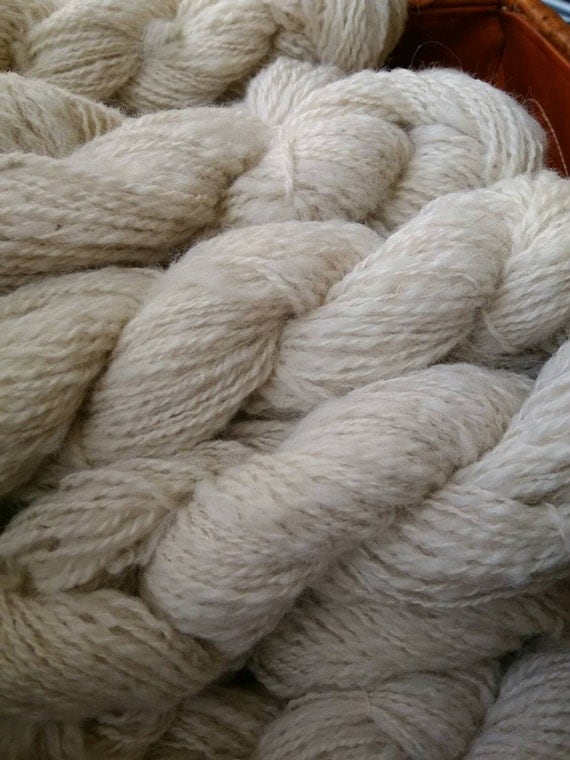
A giant pile of handspun yarn.  Fibre from Beau the rescue alpaca blended with Saltspring Island wool.  1 lb, 6 oz (at least 1500yds) of yarn looking for a new home.

Saturday, January 09, 2016

Joyful Things 7


Getting wool ready to spin.  All that potential... what yarn shall I make from you soft little balls of fluffiness?

Thursday, January 07, 2016

Joyful things 6

Little Larry use to be a lamb.
All grown up now
But still as loving and gentle as his first day.


Wednesday, January 06, 2016

Tuesday, January 05, 2016

Joyful things 4


Beau - the giant alpac who loves to dance, jump, and eat my rosemary bush.

Friday, January 01, 2016

White Rabbits - things that inspire

Here's something new, I'm making a New Years resolution.

Lately, I've been thinking about blogging.  Thing is, there is not much to write about.  Nothing exciting going on in my life (to be honest, that's the way I like it).

I'm also seeking a tool to help me focus on positive thoughts.  So I thought, why not create tiny blog posts (almost) every day about things that inspire?  Sounds good.  Let's begin.


Today's post:  Yoga

I put my mat and cloths on the floor of my room the night before, so that when I woke up my very first action of the new year was yoga.  Been at this over a month now - yoga twice a day using dailyyoga app.  Loving how it makes me feel.  Loving more that I don't need to go to a studio to contort my body.

Wednesday, December 30, 2015

exciting

We just had an earthquake.  Moved some stuff in the house and it felt like the roof wanted to fall off.  But in the end, everyone's fine and nothing's broken.

Spooked the llamas.  Had to reassure the goats.  Sheep took it in stride.

Me, I put the kettle on.  Gonna have a cuppa tea before going back to bed.

Saturday, December 26, 2015

cleaning house

I'm cleaning house as part of my New Years tradition.

Posting photos here so I can link to them from somewhere else.

First photos:  Lissajous Socks in need of knitter.


Monday, October 26, 2015

Weaving on the backstrap loom


Weaving this project on the backstrap loom has been a great learning experience.  Following an excellent tutorial, I'm weaving my very own back strap for my backstrap loom.


All that remains is to braid the ends and attach the loops that go on the loom bar.  

Some of the things I learned:

One needs something very sturdy to attach the loom to.  At times it takes more tension than most weaving I`ve tried.  

This is not the right yarn for this project.  I used 8-2 cotton which is suppose to be great for weaving.  The problem is that it clings together and pills as I switch from one shed to another.

It takes practice to get the posture right.  At first, I can only weave for a couple of minutes before my back hurt.  A week of daily weaving, and I can manage about 45 minutes.  

I need to work more on my selvage edges.  

Uneven tension in the warp shows up more than I expected and makes weaving frustrating.


On the whole, I'm very pleased.  I'm looking forward to trying some weft patterns soon.  Or perhaps a bit of tablet weaving.  

Thursday, October 22, 2015

Backstrap Weaving

Lately, I've been teaching some of my friends kids to weave.  There are a lot of lovely looms out there that they can learn on.  Kids have a natural talent for weaving and learn the basics at light speed.  What an adult takes weeks to learn, a kid can pick up in an afternoon.  

One of the problems with kids and weaving, is that many of the good looms are adult priced.  Kid priced looms seem to be shoddy things that get one excited, but are difficult to upgrade as the weaver's skill improve.  

So I decided to make my own loom based on one of the most common designs in history - and perhaps one of the best tutorials I've ever seen - A Backstrap Loom


Here are three looms I made.


Actually, I had help.  I don't like the power tools and cutting all these sticks by hand would take me an hour.  Instead, it was all of 2 minutes to cut the sticks.  Another 13 minutes to make the shuttles.  We used a piece of wood for the shuttle that will double as a sword if needed.  It's enough to get started weaving and we can expand on it as the weaver's interests grow.


The only thing that is missing from the loom is the piece of cloth - or strap - that goes around the back of the weaver.  To prove that the student is interested enough in weaving to earn his or her own loom, I set up my loom with the warp, show them how, send them home and tell them to weave their own backstrap.  They do this, they get their own set of sticks.

Here's the loom partway set up.  So simple.  A few sticks, a bit of string.


If you have a moment, google 'backstrap weaving' and have a look at some of the amazingly complex cloth people create using such simple tools.  I'm simply in awe of the inspiration and skill of people who use these looms on a regular basis.

Friday, October 16, 2015

A humming bird


Sorry about the colour.  He is much more amethyst in real life.


Never seen a fella like this before.  He sure is cute.

Wednesday, October 07, 2015

Where to find fibre flax seed - for spinning, weaving, textiles - you know, making linen!

Lately I've been having a great deal of fun growing flax, spinning it into yarn and transforming it into linen cloth.  Flax grows wonderfully well here, and when planted before the end of March, it requires very little human assistance like weeding (too cold for most weeds to grow) or watering (had sufficient time to grow roots before the rain stops).

The biggest problem with growing flax for spinning, is finding the right seed.

The flax plant we use for making yarn is the same plant as we use for flax seed, linseed, linseed oil, animal feed, and several other applications that may surprise you.  That said, different cultivars or varieties of flax are better for some things than for others.  Some flax has a short, bushy stem.  This is great if you want a lot of flowers or seeds, but not so awesome if you are making yarn.  Flax for spinning, has a single stem, about 2 to 4 feet tall, with very few branches and blossoms.  Some of how the plant grows can be influenced by the gardener.  For example if we want taller, longer stems, we plant the seeds closer together.  For the most part, the characteristics of different flax varieties have been selected for generations based on what sort of use the people wanted.


Here are some sources of fibre flax seed or seed that may be able to produce fibre for spinning, that I've found over the years.  Some of these ship to Canada only, others to the US, others to lots of different places.  


The Flax to Linen Project...

....are the wonderful people who taught me how to transform flax into yarn.  They don't have the most active of web presences, however these people are enthusiastic about brining flax into the community.  Quite often, on a sunny, summer day, you will find this group demonstrating flax processing at the local farmer's market.  The group originally began as part of the Transition movement, with the aim to preserve useful skills for future generations.

In the past, they sell seeds by donation to help fund their public demonstrations.  The seed is organically grown in Victoria, BC (well, Saanich actually).  I don't know what their current seed selling policy is, but it's worth a shot asking them if you are interested in growing your own flax.
  flaxtolinen@gmail.com

Variety: Electra - developed by Biolin Research, Alberta

I've grown this two years in a row and am impressed with how it preforms, both in the garden and in processing into linen.  I've experimented a little bit with planting timing, planting as early as January and as late as the end of May.  The late Feb plantings did best for me.


Baker Creek Heirloom Seeds...

...occasionally has fiber flax available.  Perhaps if more people start requesting it, they will bring it back as a regular item.

They also carry a few other heritage varieties of flax that look promising for fibre production. Just because they don't say these are for making linen, dosen't mean they can't be used for it.  All flax has fibre hidden in it's stem, perhaps it just needs the right conditions to make it useable.


Richters Herbs...


... also has fibre flax from time to time.

At the moment of writing, they have Evelin Fibre flax in stock, but Reginia Fibre Flax is out of stock.   They also have a listing called 'flax' which may also be useful for fibre making.  I can't tell how tall it is from the description, but if one had the room, it would be worth trying.


Wild Fibres UK also has flaxseed, however I don't know if they ship overseas or not.  

Flax for Sale is a place in the US that sells seeds as well as fibre for spinning.  They don't mention if they ship internationally.


Woolgatherers sells Marilyn Flax seed which originates from Holland.


Know of any other sources of flaxseed?  Please let me know in the comments section.

Other thoughts about flax seed.

Flax takes about 120 days to grow from seed to harvest, The first half of that time it needs plenty of moisture and can easily withstand frost.  For the last 60 days, it enjoys dry weather.  For that reason, I like to plant mine very early in the year.  I always keep back a bit of seed just in case there is an especially heavy frost, but so far, I've not needed to reseed.

I've seen several mention of flax being planted as an over-winter crop.  Planted in the fall, like grain or fava beans, it grows a little, then goes dormant until late winter when it takes off at an accelerated rate.  This seems to be traditional for the Alps and Himalayas.

The flax flower is self fertile, having both male and female parts.  It is considered an inbreeder, with an observed pollination by insect at 3% (that's less than tomatoes).  When saving seeds, the recommended isolation distance between varieties is 0 - zero what, it dosen't say.   (Breed Your own Vegetables Varieties by Carol Deppe)

It doesn't say if that information is for modern agriculture or an organic setting that has fewer pesticides and more bugs.  I've noticed when I grow flax at home that pollinators seems quite fond of my flax flowers.  So, it is possible that flax is more willing to promiscuously pollinated than previously thought.

Given these thoughts, flax may not be the best plant in the world to use for landrace gardening, but it has some potential.  I hope this year to experiment with different types of flax and different planting times.


Friday, September 25, 2015

Spinning with a friend


A friend of mine is learning to spin yarn on a wheel.  She loves creating colourful, textured yarn and I love watching her.  I'm very lucky she choose my wheel to learn on.

Thursday, September 24, 2015

Flax processing tools

dried flax plant with seed pod

removing the seed pods with a dowel

seeds ready to winnow

Once the flax is retted and dried, we break the flax.
This begins separating the boon (chaff) from the fibres

The flax is then scratched using a wooden sword and board to remove more boon from the fibre.

The flax is then passed through the hackles, starting with coarse ones like this

Long and spiky, these hackles work well.
Traditionally the spikes would not be round, but have three or four sides,
with very sharp corners

Carding cotton into punis

Cotton Boll

Seeds easily removed by
gently holding fibre and pushing out the seed

Charge the cards with the fibre

Card the cotton to organize the fibre

Rolling the carded cotton around a knitting needle

To create a puni which keeps the fibre organized and easy to spin
The cotton I'm working with for the tutorial didn't come in boll form (that's from a floral shop), but rather it's already been removed from the spiky shell and is ready to separate from the seed.  The seeds are about as heavy as the fibre, so a pound of cotton, actually makes about half a pound of fibre, and half a pound of seed.  But with luck, maybe these seeds will grow and the house will be full of cotton houseplants.

Monday, September 14, 2015

cast-on bonnet for auto knitter sock machine


There are some times in life when one simply needs professional help.

About three years ago, when my arthritis finally forced me to stop knitting, I received the  most wonderful machine: An ancient circular sock knitting machine made by Auto Knitter.  I had great fun trying to get it to work, and I was nearly there, but in the end, life happened, and it was time to put the machine away.

Although, to tell you the truth, at the time, I think I had the machine working perfectly, it was simply the user that was broken.

So, for the first time in over a decade, things in my life started to calm down and I was able to take my Auto Knitter to a mentor and see if he could fix it (or the user) so that knitting could happen.  Getting help from someone with loads of experience and enthusiasm for the machine - that was amazing.

I'm very happy to learn that it was mostly user error.  I now know how to do the knit stitch, picot edging, decrease, yarn overs, cast on, cast off, and change yarns.  Yet to learn are turning a heal and the purl stitch, but once I know those I can make just about anything.

To practice my new skills, I have been making cast on bonnets.


It's a funny looking thing, but what it does is provide an easy way to cast on stitches on the knitting machine.  Trust me, it really does.  Maybe I'll show you some time.

This one is for my 80 needle cylinder - see, 8 stripes.  I'll make one for my other cylinders once I have them up and running.


The ultimate goal, once I have the machine running perfectly, is to make socks with yarn I've spun, with wool from my sheep.  Hopefully it doesn't take another three years to get there.

Sunday, September 13, 2015

Cotton silk puni


This is my first attempt at making a cotton & silk puni.


The yarn it made was pretty good, but a bit more slubby than I liked.  With a bit of practice I think I can create much better punis (cotton roll thingies that organize the cotton for easy storage and spinning).

I have some purple silk fluff that I don't really know what to do with.  The staple length is short, only about 1/2 inch long.  So I thought, why not blend it with cotton for a long draw style spinning?

So I bought some cotton from ARaysCreations on etsy.  I bought an entire pound of it, which is a lot when it comes to cotton.  This cotton is unprocessed, it still has seeds in it.  The seeds are a bit fuzzy, so the fibre isn't super-easy to get off, but with a light touch, it come off fast enough.  Certainly faster than picking vegi matter out of wool.  I'll be saving the seeds with the idea that maybe they will grow.

To make the puni, I applied both silk and cotton fibre to the hand cards and followed this tutorial.  It spun up quickly on my charkha wheel.


Friday, September 11, 2015

Pretty handspun yarn


Merino, corriedale, baby alpaca, angora, and silk blended together on my wild carder - all little bits I had left over from teaching some spinning.  I played it with a fine single of bombyx silk that I 'borrowed' from another project.  Final yarn is textured, soft, with a strong silk core.

I've half a mind to put this on my etsy shop, but Knotty by Nature put in a request for more yarn, so It's going there tomorrow with a few skeins of alpaca/icelandic wool yarn.

Wednesday, September 09, 2015

Shooting star

Last night I saw the biggest and brightest shooting star I've ever seen.  It was huge, like an airplane and although it was bright white with all the colours like a prism, it was at the same time deep crimson.  It came in very steep and felt like it would hit the trees across the road, but I'm certain it was much further away than that.  Just before it drew even with the tree tops, it winked out.  I don't think it touched the ground, but it was amazing to see a meteor that large and that close.  I had to be looking in that exact direction, at that exact moment, on that exact day.  Half a second delay or too soon, and I would have missed it.  That rock, or chunk of ice fell into this planet's atmosphere at that exact time, and it will never do so again.

Not much later in the night, just before Tuesday finished with us, my grandfather passed away.  He had been very poorly the last few days, and in the end it was a blessing that he didn't have to suffer anymore.

Tuesday, September 08, 2015

Green cotton

Every insomniac knows, there's a point in the night when one realizes that sleep simply won't come.  For me, it's usually Monday nights, I don't know why, perhaps it's just the horrible notion that Tuesdays hate me.

Instead of venturing to the land of nod, I spent the night spinning cotton.

I call this colour - ghost of green

Beautiful, natural colours of cotton.  I'm fascinated and inspired that cotton has so many natural colours.  Browns, golden, bage, green, red, white, and I bet even more.  For more on naturally coloured cotton, check out FoxFibre - Sally Fox has some amazing cotton plants that she's bred over the years, 


off white, unbleached cotton
These days I'm working on my support spindle skill - perfecting my cotton spinning on a takli spindle.  It's very portable and fast.  Not to mention, it fits an impressive amount of thread on the shaft before needing to unwind.

Sometimes I feel like using my charkha wheel.


I've even been playing with cotton bolls and discovering different ways of preparing the fibre for spinning.


Then there's the plant...


These days, every time I want to grow something exotic, someone tells me 'it won't grow here'.  In the past, I've believed them, only to find the next year that everyone is growing it.

So this year, I've stopped believing them and decided to try cotton for myself.  So far it's right on schedule.  Don't know if it will make fibre yet or not, but hope it does.


Sunday, September 06, 2015

Rigid Heddle magazine coming soon

Recently, I received a brilliant little Rigid Heddle loom.  It makes weaving a snap and can do some amazing tricks.  But that's a story for later.

About the same time, a new magazine was calling for submissions.

A magazine about Rigid Heddle weaving.

A rigid heddle loom I saw long ago

Just a hint, it's something well worth keeping an eye on.  I don't know if I'm allowed to say any details yet, so, I'll just say I'm excited about what's coming up.