Saturday, February 26, 2022

My Treasure - Can I repair this waterlogged Singer Featherweight sewing machine?

The amount of water coming out of the box as it was handed to me, reminded me of scenes from a movie where they pull a treasure chest up from the bottom of the ocean.

I admit, I was worried.


As the history of this blog shows, I'm not a stranger to repairing these old machines - be it sewing, typewriter, or other long lost treasure.  'Though, I've never tackled something this decayed before.

Is it repairable?  And am I the person to do it?  

I hope you join me on this journey.    


Saturday, February 19, 2022

False spring


Having a retirement flock of chickens living in part of the garden makes it easy to spend more time outside.  They are each lovely with unique personalities.  

Petrichor the rooster, has an arthritic wing, but still believes he's the strongest boy on the farm.  

Lady loves to be sung to every night but won't suffer any duck but Mrs Clint - and won't go anywhere with Mrs. C.  

Nana is the mother of so many chickens hatched on the farm.  One of the oldest animals, she is slow, wise, and loves her comforts.

And then there is The Widow Clint.  The only duck I met who was 100% monogamous and who's friendship with Lady kept her going through the worst of the grief.  That and the worms we dig for her each morning.  She can't wait for the worms.

We've had a break from winter.  Double Digit Celsius days (over 60F) in the coldest month foretells a stormy spring. 

But that's a problem for future us.  

Instead, I take advantage of the sunshine and play with some yarn.

freshly dyed yarn drying in the winter sunshine

And digging the garden for when it is time to plant.  Because gardeners are nothing if not optimists.  

Saturday, February 12, 2022

Standing out in the cold - I try root retting stinging nettles

 Our stinging nettles take forever to die off in the winter.  It isn't until the hard freeze we get for a week to ten days after Christmas that they really start to die back, and even then there are hangers on.  

But come Feb, all but the most shelter nettle plants are standing corpses (with the little baby nettles already peaking up in the leaf litter).  A few days break from the rain and we can finally explore the root retting method for harvesting fibre.  

On my bookshelf, you will find,Yarn from Wild Nettles, by Birte Ford.  It's a great book with lots of ideas for, you guessed it - transforming stinging nettles into yarn.  It is from here I got the idea.

Finally, I caught the nettles at the perfect moment in our weather cycle - so it's time to see if it works.

Here's what happened:


I think I know why it didn't work. 

Wednesday, February 09, 2022

Spinning wheel options for people who can only use their upper body

 I saw a question on reddit a while back.  For reasons, they were looking for spinning wheel options that use only the upper body.  I love a challenge!  

 I'm never going to learn that reddit is the place for one-sentence answers.  But I also know that whatever is written there quickly fades away.  So, with that in mind, the following was my (rather long-winded) reply. (spelling mistakes and all)


Exciting! I love this part of the process... getting ready for the next step and finding the wheel to best fit your needs.

Before we go too much further, I do want to mention that per minute spent a wheel is more efficient (and a spindle wheel like a charkha even more so), but like two pointy sticks vs the knitting machine, per day spinning, a spindle can easily out do a wheel. The portability and freedom to use every spare moment... but you're ready for a wheel, so let's get to that.

Using only upper body. I'm imagining a long draw (like a spindle wheel), using a distaff, or an e-spinner.

Charkha - especially the book (folding up version) is very good at cotton and other downy fibres with a staple length of under 2 inches and for spinning fine thread. I wouldn't say it is ONLY for cotton (saying that a wheel is ONLY for ONE SPECIFIC kind of fibre is my biggest bugbear! That and the modern trend of calling wheels "wool wheels" or "flax wheels"... It's simply not true!) is a mistake someone who didn't know spinning made a few decades ago and it's been parroted as truth ever since. (I'll cut the rant short there).

Spindle Wheels (a charkha is just one kind) traditionally (but not always) have a drivewheel that is hand-powered, and a spindle that we spin the yarn off the tip in a long (one-handed) draw. This is one of the oldest styles of spinning wheels and is extremely efficient! Miles per hour, I can spin more on this kind of wheel than any other.

A great wheel or Walking Wheel would be the European/North American equivalent. We also had table top versions but they were less popular. In much of the world, they have smaller table top spindle wheels (in India it's called a charkha, other places have different names).

These are great for fibres under 4" and were often used for wool and cotton in North America. Most of them have a stronger spindle and motherofall than a book charkha, so they can handle coarser fibres.

In Europe, when these first arrived, there was a strong rebellion against them because the yarn wasn't as consistent as people would like (learning curve took a while to get the quality up) so they quickly got the reputation that 'wheel spun yarn isn't strong enough for warp in weaving' which was parroted along the centuries to peak in the 1970s as "all handspun yarn is impossible to use in weaving"... sigh. (another long rant later... where was I?)

I know quite a few people who spin linen/flax on a spindle wheel as this technology is infinitely adjustable for the spinner's needs.

You can also adjust your method so that you can spin worsted-style using a distaff and different drafting techniques on a spindle wheel.

Spindle wheels are far more versatile than many people realize. I know quite a few novelty yarn spinners who have converted their flyer wheel to spindle because they can get the results they want.

A GOOD e-spinner will give you the largest variety of yarn possibilities. It lets you use both hands to spin the yarn. Good not only means well made (I'm partial to the Ashford ones, but there are many well-made ones out there) but a good fit for the spinner. If possible (and this goes for any spinning wheel) see if you can try one before you buy. Some yarn shops have them that you can use.

Adapting a treadle machine to hand powered: I haven't... but it sounds awesome. I would go with a Saxony style (big wheel to one side of the flyer). Cut the legs to make it tabletop compatible... or adjust them somehow for the right height for your body. Take the treadle and footman off as well. You could turn the spokes with your hand like a great wheel, but I almost feel I would reverse the wheel somehow so that the axel is facing towards me and I could put a handle on it.

Drafting one-handed isn't awesome on a flyer wheel. Simple to convert it to a spindle wheel... but there are ways to spin without doing that. Distaff mentioned earlier will probably be the best method. Long draw for woolen style yarn also works.

And I've written a huge essay. Sorry.

Let me know if you have any specific questions. I'm excited about your adventure and would love to learn what path you choose.

Saturday, February 05, 2022

It doesn't madder what colour I get

 Confession time: Dyeing scares me.

(dyeing - as in making things colourful)

There is so much science about it - and as much as I love geeking out and learning the details, I also get lost in them.  

What if I do it wrong?  What if it's ugly?  What if... 

A few months ago, I was putting my garden to bed for the winter and I was thinking about this list of what if's, probably because I was digging up some madder roots for a new garden because I love the colours madder makes and you can never have too much.  

I put aside about a third of the madder root for drying and dyeing at some later date.  Because one day I'll know enough to be able to use it.  I've never seen instructions for dyeing with fresh root before.  Maybe it's not possible.  Someone would have told me if it was.

Then I started to get angry at myself. Why don't I just do it?  It's only yarn.  I've got nearly 5 kilometres of handspun yarn ready for just this sort of harvest.  It's not like I need a specific colour, all I want are pretty reds.  What keeps stopping me from dyeing?  

The answer, I'm sad to say, is me.

So I designed an experiment based on what I know about madder.  Scared that I might destroy all that handspun yarn, but excited too that I could finally do this thing.    


It's so pretty!  


PS, don't miss out on the easter eggs at the end of the video.  

Saturday, January 29, 2022

Stuff, repair, repurpose, Kintsugi (金継ぎ)

About a year ago, some stuff happened.

It looked something like this, only not. 


An injury. 

Nearly 12 months later, I find out what is going to heal on its own, would have by now.  

I'm not good at accepting that.  

But there are some therapies that are show promise.  Believe it or not, the health system pays for me to go to mindfulness classes.  As if this is the glue that will help pull the pieces back together.


I'm beginning to realize, even if I could find all the little missing shards, it won't be what it was before.

Not the same.


 But it's a really cute mug... I mean, it's the only life I have.


So what do I do?


I look at what remains.  Find something to fill in the gaps.  Hope.


Most of all, I repurpose.  


They say it will help, but mindfulness, especially the guided stuff, bores the pants off me.  

And yet, it meshes so well with my learning of photography and videography.  The camera sees what's actually there.  To capture the moment, we too need to see that moment.  To be attentive, not with judgement, but with a curiosity of everything the camera sees and hears - and what it doesn't.  

So maybe my instinct to make up for what I have lost from the written world by learning new visual skills, is a way of healing?

But also there is grief.  But that's part of healing too.  


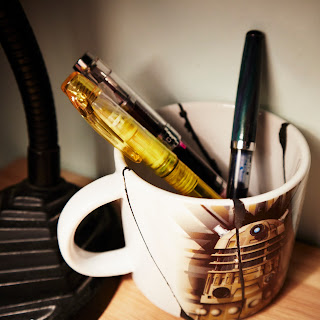
This mug was a Christmas gift.  Part of a set and all the others arrived with loving perfection except this poor shattered Dalek.  I looked into different ways to repair him, and although I would love to one day try Kintsugi (金継ぎ) which is a repair with lacquer and gold and I'm told does such a good job the mug is 100% useable again.  I couldn't find a traditional kit (most modern ones use chemicals that aren't food safe or heat resistant enough for tea) in my price range.  Maybe one day.

For now, I have a protector for my fountain pens.  

Use at your peril. 

Saturday, January 22, 2022

Some thoughts on vintage sewing machine repair - coming back to it after 10 years

It's been 10 years since I've last worked on a vintage or antique sewing machine.  I actually sold most of my parts (keeping only a few prized machines for myself and some parts machines if they break) and moved on to repairing other things.  I love working with sewing machines, but the truth is, there was very little interest in these beauties and almost no good resources online on how to fix them.

The few sewing machine posts I have on this blog, are some of my best-performing pages.  The interest goes up every year and thanks to the ads on my site, I'm earning between 1 and 5 cents per week from them (not much, but every little bit counts).  It's amazing how much more interest there is now than 10+ years ago when most of them were written.  


A thing happened the other day and I brought home a sewing machine that would, to any sane brain, be considered well and truly beyond repair.  

Guess what?  oh, you guessed.

That's right, I'm going to see if I can repair it.  


I know the worst thing to try to fix is a bad repair, so I'm taking this slow and doing my due diligence.  I'm spending a lot of time with my friends duckduckgo and google to see what new information is out there and WOW!  The interweb is flooded with advice on how to repair and restore vintage sewing machines.  

Most of that advice is horrible!  I know this because I've spent many hours repairing the kind of damage following that advice causes.  

About 5 to 10% of what's on the internet in this area is good advice.  About 50% of what is left is okay, but not going to give the long term life that one wants or cause unnecessary work (most common seems to be removing the shellac or "clear coat" because they mistake it for caked-on oil and grime).  The rest of the advice, I'm not sure if it's well-meaning or written by people who want the value of their machine to go up by destroying the existing machines.... evil laughter. 

So the ratio is about the same but the quantity to shift through is so much more.  

Although I am loving how much of this is on youtube now.  But restoration videos are one of my favourites.  I wish I had a sound safe studio space where I could make some ASMR repair videos for you all, but alas, something to dream about in the future - living in the country is NOISY (tractors, cars, planes, roosters, geese, sheep... )

Anyway, I really like this guy, as he doesn't recommend things I know will damage the machine.  


Some of you have probably already guessed what my new treasure is from the photos.  For the rest of you, all will be revealed as I'm going to document this project on my youtube channel.  

But evaluating the machine, I also notice that I'll need to spend quite a bit more money on this restoration than usual.  It needs new paint, and paint stripper and... I don't even want to think about it yet.  Some of this I can improvise.  Some I cannot.  On the whole, I would be very very lucky if the cost of materials to restore this were less than the final value of the machine.  Also, I might keep it as a forever machine.  I haven't decided yet.  

It's important to me that every hobby be self-funding, so part of this project is looking for creative funding ideas.  Youtube now gives me money for ads (at just under a dollar a day for all my videos, so you can guess how small that is per video).  But I also don't turn on all the advertising features like commercials that show up in the middle of the video.  I can see clicking all the boxes for these sewing machine videos to see if I can the machine to fund its own repair.  


In the photos, some of this is rust, most of it is old grease and oil.  It will be interesting to find out how much of each.


Happy sewing everyone!  


Wednesday, January 19, 2022

Experienced shepherdess seeks bummer - only ewe lambs need apply.


I am looking for a young ewe lamb or two to hand raise and join my flock.

I have a small fibre flock and work from home.  I love spending time with my sheep.  But we aren't lambing this year and I miss having the little bleaters underfoot. 

I would like to buy one or two young ewe-lambs, not yet weaned.  Preferably a bummer that the mum is unable/unwilling to care for. 

I have no specific breed in mind, but I would like it to be a squishy wool good for sweaters and socks (most of my current flock are Cotswolds).  A Suffolk or Suffolk X would be lovely for sentimental reasons.  Will consider "meat" breeds as they often have lovely fibre - what keeps a meat sheep happy and healthy also makes good wool. 

This will be a forever home.


Rams, wethers, and hair sheep need not apply.


Saturday, January 15, 2022

Self identity - Spinster

Even before I knew the history, it was a word that sang to me. I love the word spinster. 


It might be that childhood worry that every story was about the boy meeting (and often rescuing the girl) and they living happily ever after.  I like the ever after part.  But why was it impossible to be happy without being married?  

Why does one need a second person to become complete?  

And what happens after "happily ever after"?  

There was so much missing from those stories.  I liked better the stories about the boy getting lost while walking down the street and finding his way home again by remembering all he had seen, or the one where the boy plants some beans and has an adventure only to come home with everything all better.  And then there was the train who thought he could, and he did.  Pretty nifty stuff.  Each story had lessons I could use (take note of where you are going, 5 magic beans will buy a cow, and keep on keeping on until you get somewhere or bow a gasket).  

So when I found a word for "woman who lived happily ever after without a handsome prince to save her." I was happy.  Only to find out too soon, that Spinster was an evil word in our society.  One to be avoided.  The Old Maid to be pitied and given charity.  

And yet, Bachelor is a word meaning joyful single man who is having lots of fun before settling down.  

That didn't seem fair.


The other day I was in a second-hand shop.  I saw the most gorgeous mini sewing machine (more on that later).  By some miracle, it was within my budget.  (it needs a bit of love to get it working, but I'm up for it).  

I asked the front desk to hold the sewing machine while I had a quick look around.  When I returned, the woman behind the desk was trying to sell the sewing machine to an older man.  I think she was flirting.  But what stuck out most was the words she said as I walked towards the counter.

This would be the perfect sewing machine for a bachelor like yourself.  

My reply, It would be even better for a spinster.  

Her reaction wasn't anything to do with me interrupting her flirting or that she hadn't seen the 'hold' sign on the sewing machine and was trying to sell my treasure.  

Her reaction was that I used the word Spinster.  

I couldn't have gotten a stronger reaction if I did something evil in a church (not sure what evil things people do in churches, but I imagine a room full of outrage and shock and an immediate storm of voices trying to fix the unwanted behaviour - something like Reddit, but better dressed).  

The word Spinster is not to be used in public.  She made that quite clear.  

And yet, the word Bachelor is a compliment.


I love that we now live in a world where people can self-identify.  They can choose their own pronouns to match their true self.  Once again people are able to choose their own gender roles in society and not be restricted by the nature of their birth or upbringing.  Even ACE (asexual) is starting to be recognized as a real thing and not an illness.  We live in exciting times.

And yet, Spinster is still treated as a dirty word.

I was born female.  And I was born unmarried.  If Spinster is a dirty word, then we are saying that my birth is unacceptable.  I don't feel that's right.  

Spinster has a second meaning.  An older meaning.  A meaning from long before it had any relation to marital status and happily ever afters.  It means a person who makes their living spinning yarn.  

I make my living spinning yarn.  


Spinster is a beautiful word filled with history and romance.  It is self-contained and implies that happily ever after can live in one person.  I don't need a prince to rescue me just yet.  I'm having fun.  

Friday, January 07, 2022

Distaff Day 2022 - where I dress sticks in wool

We look at the past and forget.  

It's easy to do.  We forget that the spinners of years gone by didn't spin yarn for fun, or to save money or for sentimental reasons.  They did so because, without yarn, they were bloody cold!  

Yarn is survival.  

All the incarnations.  Be it string, twine, rope, thread, yarn... all was made by hand and without it humanity couldn't thrive in the extreme environments that we do today.  Yarn binds us together as a species.  

What amazes me most of all is how universal yarn production is.  Every culture that makes yarn has three steps (draft, twist, stash).  Sometimes these are done by different people (Cowichan Nations and Ancient Egypt), but always the same three steps.  Draft, twist, stash.

And almost universal is having something to manage your fibre source.  Often this is a distaff.  

If it was as clumsy as it feels to my modern hands, people would have given it up long ago.  And yet, even well into the 20th Century, handspinners who are connected to their cultural roots and a time when spinning yarn was a survival trait, still used distaves (plural of distaff).  

Last year, I set out to perfect my distaff spinning skills.  I got pretty good at it, but I also learned that one year is not long enough to master this skill.  There is so much more to learn.

But... I did learn lots and here are a few methods I found work well for me for dressing a distaff with wool.


There are as many ways to dress a distaff as there are spinners who use them, so try lots of things and find out what works well for you.  There is no wrong way so long as it gives you the results you seek.

Saturday, December 25, 2021

A special treat on Christmas Morning (or Holiday Day as I call it).

 Does anyone else get this obsessiveness?  An idea in the head and the whole of life and cleaning house and everything cannot happen until that idea actualizes?  

Just me then.

Well, I don't know where it came from but one morning I woke up needing to build a thing.  I had no idea how to do it.  But it infested my every waking moment.  

So I made the thing and I made a video about making the thing.


It's not perfect.  It's not even close.  But I made it.  I ate it.  It was DELICIOUS! 

It's amazing how much you can learn about a thing by making it out of gingerbread.  It also inspired me to learn some special effects for the video.  

Happy Holidays everyone!  


Saturday, December 18, 2021

The best way to learn how to build anything!

There are things you know you know,
things you know you don't know,
and even things you don't know you know.  
But it's the things you don't know that you don't know that will get you in the end.
-paraphrased from some politician I can't remember.

I've been working with spinning wheels for nearly 20 years.  Repairing, assembling, using, spinning, buying and selling, teaching, technical support, writing, researching, and other adventures.  I know a lot about spinning wheels.  

Or at least I thought I did. 

What I didn't know is how much you can learn by building a spinning wheel out of gingerbread.

That's right, gingerbread.

Gingerbread must be the most unforgiving substance to build from ever!  Rigid when you don't want it, crumbling at the wrong moments.  Even making the parts thicker doesn't guarantee strength.  But rather, understanding the forces at work and the stress points is key to successfully building something out of this crazy material.  

I learnt more in two days of failure and one wheel-shaped object than I ever knew I didn't know.


My first attempt was not as awesome as the image in my head.  Actually, it has no resemblance to the image in my head at all.  

But I kind of think I might try again next year and see if I can do better.  


If you want to build or repair spinning wheels, and you want to do it well, build one out of gingerbread.  You will learn more than you ever knew you didn't know.


Saturday, December 11, 2021

Can I sell my handspun yarn? Here are some tips from an expierenced seller.

 Another one of those "this is something I wrote elsewhere and wanted to keep a record of so I'm reposting it here" kind of posts.  There is a lot more I could say on the topic, but I need to leave something for me to write about in the future.  For now, good enough is good enough.  


Selling yarn in person!  I'm so glad you are thinking about this.  It's so much fun!


Some things that help:

  • Make stuff with your yarn! Seriously. This is the best way to improve your spinning by working with your yarn and learning how to improve it.
  • Have samples of what you made so people can see how the yarn behaves.
  • Make yarn in large batches. My batch size is one kilo. People want to feel confident they have enough yarn for their project.
  • Make the skeins all the same size and price (400yds is enough for a pair of socks and is a good length for most yarn)
  • Have ball winder and swift on hand and offer free use of them (get the ball started, and get the person winding their own if things are too busy)
  • Price according to the time it actually takes. Don't take less than minimum wage.
    • Hint, if you don't know how much your time is worth, use the 'broken arm' standard.  If you had a big order and you broke your arm, how much would it cost to hire someone to make the same quality yarn?
  • Do some time and motion studies on yourself. Get a stopwatch if you don't have a phone that can do this. Find out how long it really takes.
  • Pricing too low often (subconsciously) indicates the quality will be low and people don't want to buy it
  • Specialize - make only sock yarn or only sweater yarn until you are perfect at it. Make knitting yarn or crochet yarn.


Most important of all:

Learn to FINISH the yarn.

Finishing includes many steps, but basically, we are handling the yarn several times over distance. So when I take my yarn off my bobbin, my skeiner (a click reel because I'm measuring at this stage because the other stages expand the length of the yarn by about 3% and I want the customer to get the best value) is about 8 yards away from my bobbin. Then I wash the wool and block it. To block, I put it on the swift and put the blocker at least 8 yards away from the swift and rewind it.

The distance helps distribute the twist and handling it each time helps you see if there are any flaws.

If you are selling to weavers, wind under tension so that if the yarn will break, it will do so now, not on the loom. fix the break by tieing a knot big enough for the fingers to find when the weaver is working with the yarn.

If you are selling to knitters, a splice is better as they don't like dealing with knots.

From my experiments, garments made from finished yarn pill less and last about 6 years longer than ones made from 'right off the bobbin' yarn.


Also, you are going to get people complaining about the price - no matter what the price is.

When this happens I offer to teach them how to make their own.

They reply: oh, I couldn't possibly have the time or the skill to make that.

I stay silent and try to keep my face friendly and confident. maybe nod slightly.

They usually buy the yarn.

Saturday, December 04, 2021

A little bird told me... sewing with a sewing bird (and how to make your own mocking sewing bird)

It is entirely possible I made this entire video so I could reference 3 seconds of a Dr Who episode.

I've been wanting a sewing bird since long before I knew how to sew.  I'm frugal with my spending and antiques are far too expensive.  The brass reproductions are pricy enough.  But I put a price watch (camelcamelcamel.com is great for this) on my dream bird with the expectation it would never drop that low.  But it did.

The sewing bird is designed to solve a major problem with hand stitching - back and hand pain.  It is supposed to give more control of the needle and fabric.  And having tools that inspire makes it easier to avoid procrastination.

Before I spent money on it, I decided to try an experiment.  Could I make a tool that would do the job with random things found around the house?

SPOILER: Yes.  Yes, I can.

So here you go.  My adventures hand stitching, making a mocking bird, and finding out if a reproduction Sewing bird really works.


I hope you enjoy it.  

There are a lot of things I could do better, I know.  But this video marks yet another big step towards making the videos I want to make for you.  There is a lot more focus on storytelling as well as - what I hope is - informative and useful information.  


If you like this sort of thing and want to see more of it, here are some things you can do to support me on my creative journey.

- go to youtube and give me a thumbs up!  Or even a subscribe!  That would be awesome
- or pop over to my Etsy shop and support me that way.

Saturday, November 27, 2021

Why I hand sew so much more these days

 Given how bad my arthritis is getting, I would think I would give up sewing by hand, but I find I do it more and more. My sewing machine is actually tucked away for a while but I'm still working on a few projects like a sleep shirt and new skirt.


I've been thinking about why I hand sew so much these days.

It's not because it's fast. It's not because it's easy. It's certainly not because it's painless. I'm not very good at it and my stitches are still uneven.

These are also the factors that keep me coming back.

Arthritis - the doctors say keep moving those hands as therapy.

Easy/not good at it - I love learning and perfecting new skills.

Slow - that's a bonus. I took a mindfulness class about the same time I started sewing by hand and I found out a lot of the things we learned in that class are easily applied to hand sewing (And making tea, and lots of other things). But I find I like the slower pace as it increases the value of the finished item in my mind. It encourages me to maintain and repair it for a longer life.

Sometimes I think maybe it isn't as slow. I spend a few moments here and a few moments before bed and before I know it the top is finished. Whereas with the sewing machine, I need dedicated time and I can't always find that in my day.

Sustainability/preparation - something I can do if I ever lose my sewing machine or other adverse events happen.

And portability. It's nice to have something to do in those empty moments while out and about somewhere.


If you like this sort of thing and want to see more of it, here are some things you can do to support me on my creative journey.

- go to youtube and give me a thumbs up!  Or even a subscribe!  That would be awesome
- or pop over to my Etsy shop and support me that way.

Saturday, November 20, 2021

Fun and foolishness


Nothing serious today, just a fun video of Beau, the rescue alpaca eating apples.

Because... why not?  

Tuesday, November 16, 2021

Current events - everyone's fine - Nov 2021

We had some rotten weather this weekend.  Thankfully the worst missed us.  We're fine but tired.  

Most of all, enjoying the return of the sunshine. 


Keeping warm during the power outage was fun.  But it's also an excuse to get away from the computer and play with some yarn.

Got over some procrastinations on a big project I'm working on.  

Although I would have liked to do some more sewing, the lack of light (and lack of a non-electric iron) kept me playing with wool.


Stay safe all.  I hear it's bad out there.  

Saturday, November 13, 2021

What time is it? Time blindness and watching out for a watch.

 I've always been a bit time blind, but lately, it's gotten a lot worse.  I've been musing on what to do about that.

 Many years ago, I had a job where we had to be on time within 10 seconds of the schedule.  We had all the responsibility for making certain everything was on time and absolutely no control over the factors that caused things to be late.  That kind of disconnect is demoralizing.

Not long after leaving that job, I stopped wearing a watch.


Now that I live on the farm, wearing a watch on my wrist is a fast way to destroy a watch.  

Besides, the chickens don't care what fiction the watch tells us.  The day begins as it gets light, and ends as it darkens.  That means in the summer, my day ends at about 11pm and on Christmas Day it very seldom lasts beyond half-past two in the afternoon.  


It happened there was a doctors appointment the day after Daylight Savings ended.  And of course, the confusion;

"I thought you changed that clock."

"No, I thought you... any idea what the actual time is?"

Yep.  The same old conversation.


I've been thinking of wearing a watch again.  But a wristwatch is out.  I'm resisting getting one of those smartphones.  That leaves a fob watch (pocket watch).  


I dug out my old fobwatch which is a cheap mechanical watch in a lovely umeboshi case that never kept the time.  Now I remember I took it apart at the start of the year to find out why it was broken and if I could move noon to the 9 Oclock position.  I figured out how it was broken, but I didn't have the skills to make it unbroken... and I ended up making it much worse.

My first choice would be to fix this watch.  I really like this case, but I haven't been able to find replacement watch guts for it.  I wish the only horologist wasn't all the way downtown as I only go there once every five years to get my drivers' licence renewed.  

The second choice is to find a new mechanical (one I wind up every day as batteries only last a couple of weeks on me) watch I can love.  I haven't found one in my price range yet.  I will just have to wait until the time is right.


But there's also the issue of pockets.  

Perhaps if I add watch pockets to all of my skirts, by the time I finish, the perfect watch will appear?

To that end, I found this awesome video on historical methods of putting watch pockets on skirts!


It's given me some good ideas I want to try.

I really like the information in her videos.  The sound is a bit difficult, but the captions help. 


If you like this sort of thing and want to see more of it, here are some things you can do to support me on my creative journey.

- go to youtube and give me a thumbs up!  Or even a subscribe!  That would be awesome
- or pop over to my Etsy shop and support me that way.

Saturday, November 06, 2021

Willowing in the garden - Overcoming two self-imposed speed bumps

 Why am I hitting fluff with sticks?  Read on my friends, it's fun.

You know how you read or watch a nifty thing and you think you have the skills to do it.  You just never take that final step to trying the new thing.  Maybe you aren't confident you will do it right?  Maybe you let yourself get stuck on the tiniest detail (how long should my whippy willow rods be - I need specific numbers people!  How many inches?  No one will tell me, never mind, I now have a good excuse to return to my comfort zone.)

My friend Brenda took away my excuse not to try this nifty thing.  During the Virtual Sheep to Shawl, she set up a willowing station.  It was so much fun, why wait so long to try this?  

So I did what I do, and I took my new skill home and pushed it to the limits to find out what it can and cannot accomplish.  While exploring this skill, I discovered that there aren't many resources for it on the internet, so I made a video.  


The problem is, it's not the kind of video easily done within my comfort zone.  

My preference is to have as little as me as possible in the film, be it visual or voice.  I'm not that interesting, why would anyone want to waste their time listening to me... or so the voices in my head tell me.  

But this is more limiting than liberating.  I have a list (currently 5 pages long) of videos I want to make for you, but I don't want to make half-ass videos.  Each video I make, I want it to build my skills and to provide something useful to the world.  I have a lot to say on many topics and doing it silently wouldn't do it justice.  

I'm not sure if I'm saying this clearly.  

But learning the skills I need to make better videos is like flogging myself with whippy willow rods.


This video passes a huge milestone in my journey.  I cannot say how much courage it took, because I suspect for most people, this act would take no courage at all.  

Put simply, I do a lot of talking.  A voiceover for the whole video describing with a touch of storytelling in hopes of making a technical tutorial interesting. 

Emotionally and physically this is exhausting.  But I did it.  I published it.  No one yet has noticed (or at least mentioned) the mistakes I made with my speech impediment (mid-Atlantic accent mishmash that let a few regional flaws slip through)

These videos take longer to make, so I'll probably be alternating between longer with talking and shorter something silly videos for a while.   At least until I get into my grove.  

But it's a lot like willowing - a lot of fun and I don't know what took me so long to try it.  


If you like this sort of thing and want to see more of it, here are some things you can do to support me on my creative journey.

- go to youtube and give me a thumbs up!  Or even a subscribe!  That would be awesome
- or pop over to my Etsy shop and support me that way.

Saturday, October 30, 2021

Washing wool - Why do I use orvas paste?

 I'm desperately trying to wash the rest of the wool before the rainy season sets in.  Even on hot summer days, it takes two days to dry the wool enough for long term (air/bug tight) storage.  In the winter (aka, rainy season)... well, it's a challenge.

The other challenge is in the warm weather, the animals get first priority with the well water.  So there aren't many days when I can wash the wool.  

Washing in the garden helps, because then the dirty water not only waters the plants but it adds a lot of benefit to the garden.


So why do I use Orvas Paste?

Orvas paste is pretty much pure SLS (sodium lauryl sulfate) which is extremely unpopular in cosmetics and soaps these days.  SLS makes a lot of suds and is often added to shampoo or detergent to make it look like it is working.  We are trained that bubbles do the cleaning (this is not true, but it is believed).

A lot of people have skin sensitivities to modern detergents and soaps. Quite often SLS gets blamed for this.  So they buy things that are SLS-free.  Their skin gets better.

Sometimes SLS is the cause.  But more often, I suspect the problem is poor quality control of the ingredients.  If a company takes the effort to remove the most common additive, then it is probably paying a lot more attention to the ingredients that do go into the product.  

I think this for two reasons.  One, quite often I am washing wool with someone and I stick my hand in the Orvas Paste and they stick their hands in it either.  Then they comment, oh wow, this is awesome stuff, I normally get a rash.  Then they panic from it being SLS.  But still no rash.  

The other reason is my own skin is hypersensitive to just about every soap.  Even real soap made from lye and oils can cause massive blisters.  Orvas paste is one of the very few things I can use without hurting my skin.  

Orvas paste is often used to wash babby animals, like lambs and goats.  

It's also quickly biodegradable so it's safe to use on the garden without having to dilute the wash water first.  Most other washing substances I've tried, kill the plants - always test on a section of lawn before using in the garden.

Most of all, I love how quickly it rinses out of the fibre.  All the other detergents and soaps I've tried, take a lot of rinses to get the residue off.  


But if it causes a reaction to your skin, then don't use it. Test a small area of skin first. 

Also, different cleaners react differently with different minerals in the water supplies, so always do a small batch to test.


Orvas paste:

  • doesn't hurt my skin
  • doesn't kill my plants  
  • biodegradable
  • mild insecticide in the garden
  • need very little (1-4 Tablespoons per fleece) - it actually works better with less
  • extremely affordable $40 for enough to wash a hundred+ fleeces
  • great on protein stains (like poo, urine, and blood)
It's not the thing for everyone.  But it works for me.  


If you like this sort of thing and want to see more of it, here are some things you can do to support me on my creative journey.

- go to youtube and give me a thumbs up!  Or even a subscribe!  That would be awesome
- or pop over to my Etsy shop and support me that way.