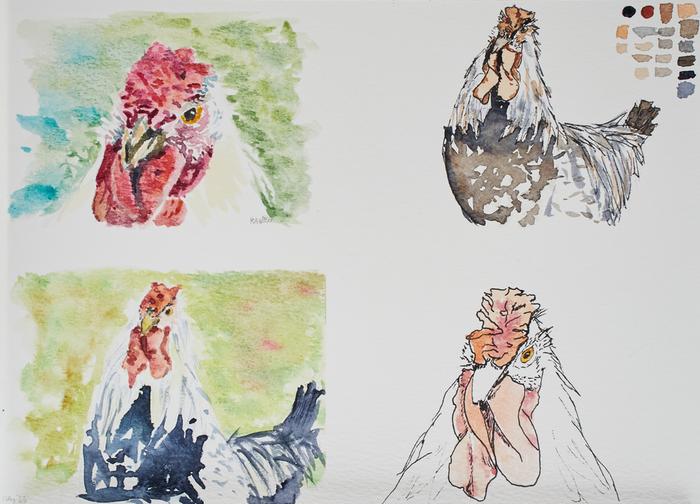
The second thing that must happen is a Wizzard! (comment if you know why it has two Z's)
Here our Wizzard is having a walk in the potato patch. He loves potatoes.
Only, it goes all wrong somehow.


Details on how Nicole made this mighty wizzard here.
The second thing that must happen is a Wizzard! (comment if you know why it has two Z's)
Here our Wizzard is having a walk in the potato patch. He loves potatoes.
Only, it goes all wrong somehow.
Details on how Nicole made this mighty wizzard here.
this is me just showing off another needle felted chicken by fairy grove creations

And my other favourite thing - coffee!
(make note of how small that coffee plant is in the coffee bag, it comes back later)
To understand the next painting, two things must happen.
First, chickens!

This is needle felted henny penny! You can get your own epic chicken here.

It's amplifies what I love about watercolours - the paints participate in the creation. They flow and granulate adding texture and surprise.
A review from a new painter of HannahLouMyers handmade watercolours and a variation on the review I wrote here.


The magic of using good quality materials is something any craftsperson can relate to. Like carving a beautifully grown apple branch into a spoon or knitting with lovingly handspun yarn. Spaghetti sauce from homegrown tomatoes. The materials add a flavour to the final project that is more than knowing where our ingredients come from, it adds a feeling of life to the final creation.
So when I started learning how to paint this summer, I looked around for handmulled paints that would give this feeling to my paintings. Commercial paints are lovely, but they feel like the pigment is flat on the paper and it takes a lot from the artist to add that extra dimension to the painting. Thus the quest for handmulled paints began.
I suspect if I had spent as many hours painting as I did seeking out the perfect handmade paints, I would be a master painter by now. But I finally settled on HannahLouMyers' handmade paints on etsy and I am over-the-moon happy with these paints. (I just hope I'm worthy of them).

They look like handmade chocolates, but the inside is even better. I bought the set of 6 handmade watercolour half pans in a tin.
Okay, I want to stop here and say that these paints smell amazing. Like all the good memories of winter holidays in one tiny tin.
The ingredients include clove oil for preservation and honey to help the paint flow smoothly. Local honey! This is another reason why I choose this maker as the shop is just the next city over and they source many of their ingredients locally.

I hear you saying "alright already, but how does it paint?"
Before I decided what colours to get, I bought some dot cards. These are small mounds of watercolours on a bit of paper we can use for swatching. HannahLouMyers has generous size dots that I was not only able to see what the colour looks like, but to swatch and do some colour mixing to see which combination gave me the most versatile and useful palette.


I am really glad I got some dot cards first because I had no idea that paints could be so lively. It's not just the colour, but each paint has a personality it adds to the painting. Some of these paints are so textured you can feel it on the page and it makes the most marvellous effect. The thing is, I've only been painting for two months and I worried that my skill wasn't up for those paints... yet. So I chose some of the calmer paints.
The Colour Theory or Primary set has great mixing power so they were an obvious place to start. The more muted yellow and red (forsythia and maple) are very much like my most used colours of yellow ochre and burnt sienna. But different enough that I'm going to have fun learning what these paints can do. As for choosing brine... well, that was an oddball for me. Of all the colours I swatched, that was the one that sang to me most of all. I don't know why or how to use this colour but I just knew it would improve my painting if I tried it.
So, the next step is to swatch out a little cheat sheet for my tin until I can get to know the colours better.


I love this little set and the only big adjustment I've made is to add magnets to the bottom of the pans so they don't rattle around.
And a final comparison between commercially made paints and the hand mulled watercolours.

The commercial paints have the advantage of being consistent and predictable. But when I see them next to the handmade watercolours, the handmade paints look more lively and the commercial ones flat.
I'm very excited to try out these new paints, but I'm also worried that now I have them, I will be too afraid to use them because I'm not yet good enough. I need to find something too paint soon so I can get over the fear. There's no point having beautiful paints and not using them.
additional to the original review:
I love these paints and I especially like that they include pigment information. The pans are overflowing with paint and considering these are cheaper than commercial paints, I am definitely getting my money's worth.
What I didn't mention is how long shipping takes. I've had things arrive the same day from that city, but it usually takes 2 to 3 business days to get here. I'm very lucky if I get my order in under 3 weeks.
The paints are less consistent than commercial versions, but I kind of like that as these paints participate in the art instead of just sitting where I put them.


It didn't go well.

From here on, it's pretty much a mix of mostly Cotman paints being slowly replaced or supplemented with Van Gogh (my favourite student grade), Winsor and Newton, Rembrandt, and Holbein when I can afford or find it. Unless I specify otherwise.

It's tricky because he's a black chicken but the black isn't black, it glows lots of colours.

the idea is the background would be part of the shimmer of the feathers.

you can see him in his full glory helping in the garden

Cotman watercolour but still, I have a lot to learn.
For years, I avoided weaving with linen, and when I finally tried it, yep. It's hard. So hard that I sent my loom to a friend's house to finish off the weaving, and even she had trouble.
I've gotten to know linen a bit since then, and here is basically the video I wish I had watched when I was a new weaver. How to make weaving with linen easy.
Distaffs (or distaves) are used for all sorts of different fibres. It's basically a third hand that holds the fibre while our other hands are busy spinning it into yarn.
Distaff Day is on the 7th of January and is the most important holiday in the spinner's calendar. Well, I say holiday, but it's actually the back-to-work day but we do it with great fun.
This year, I dressed distaves in flax fibre for spinning linen yarn.
Here's a free PDF guide on dressing a distaff with linen fibre.
Last year I did the same with wool
Now, how do I up my game for next year? Anything about distaves you wanted to know?
Chaotically

So this is a list I made for myself. This includes the videos I am actively working on and if they have any deadlines (and yes, dyslexia is a thing - don't even bother correcting, I promise it will do more harm than good).
To get on this list, the video needs to be in the filming, editing, writing, crafting, or gathering materials stage. The list fails to include some of the long-term projects where I'm gathering footage over several years (I started a flax video in 2019 for example), videos still in the planning stages, or videos that got stalled in the editing due to not having the right story to be worth making... yet. There are also a few secret projects that won't make it into this either.
What unexpected yarn has fallen into your life? Do you have a go-to project you love to make with found yarn or do you wait to see what the yarn says it wants to be?
About a year ago, I stumbled on some free yarn, leftovers from the now closed local mill. Talking to people who used to work there, this was part of calibrating the spinning machine, so it contains a lot of different fibres from a variety of farms. Most of them are less than a day's journey away.
So I made a thing. And I made a video about the thing. And the yarn. And deep thoughts about the yarn, fibreshed, and my personal textile history.
Layers!
Hens are great layers. But even better are clothes layered on top of each other. It transforms a seasonal outfit into a multi-season extravaganza!
Winters on the farm are muddy, mucky, bloody, and occasionally snowy. I do a lot of laundry.
Come lambing season, I can do two or three loads of laundry a day.
So I want farm clothes that wash well, like cotton. Only the problem with cotton is that it's not very warm. It actually, what's the opposite of warm? A single layer of cotton is terrible for working outside in the winter because if the cotton gets wet, it chills the human and can cause health issues. So we could be forgiven for thinking that if a single layer does harm, a lot would do more.
Layering the clothes creates air gaps that allow the skin to breathe and provide insulation so I can stay outside longer to get things done. And since I often wear skirts or dresses when working on the farm, I can take my fall and spring cotton skirts and transform them into winter skirts by adding a petticoat or two underneath.
This matches well with my capsule wardrobe goals.
Winter has been a bit meh this year. A bit of a health setback before the Holidays and the only game we get to play on the farm is catch-up.
I've also been working away on several projects and finishing almost none of them.
But finally, I got one done! Just in time for (what I hope is) the last snowfall of the year.
If you like the video, please pop over to youtube and leave a like or even a comment as it helps me out tremendously.
And here is the full playlist that takes us from sheep to finished cloak!
I enjoyed this project. It's the first time I've made something from sheep to clothing that feels like a quality garment. What's more, it's a sheep from my farm! One that I feed every day and who loves cuddles.
In a lot of ways I've gained confidence. I understand better how the yarn behaves in the woven cloth and that I can actually make something from scratch. I also understand why a more historically accurate cloth would involve a lot more people: a shepherd, weaver, spinner, seamstress, etc. It seems almost that I lose as much as I gain doing each step myself.
One of the things I worry about is this sets the bar too high. Both for me and for viewers.
There's no need to do every step ourselves. I did it because I was curious if I could and I'm a cheap little chicken who can't always afford to buy the cloth I want to work with. Even in this project, I combined modern cloth with traditional methods. Add growing, spinning, and weaving the lining to the mix and I would need another year or three to get it done. But even then, I don't think it would have been as good for the cloak as the lining I choose.
It's about learning from history instead of trying to reproduce it. What can I learn from the past and how can I incorporate it in my life today. There's no shame in it. There's no shame if a future project has bought yarn or I go to the shop and buy fabric. And yet, it's a nagging worry that I now need to progress to better and better things, especially on my youtube journey. That's not the path I want to take. I want to make projects that fill me with joy, and sometimes that means buying yarn. Sometimes it means spinning it.
Sometimes there won't be any yarn involved at all.
Most of all, I'm happy with the improvement in my video-making skills. I'm getting better at what to film and what to leave out. My voiceover confidence is improving. I'm still seeking a balance between showing enough for the technically curious and keeping the story moving, but on the whole, I've moved up a notch and am now about 11% of the filmmaker I want to become.
So I did what I do when I want to make something new. I got out a load of books from my library, the old family recipes, and my historical cookbooks. This is the recipe I came up with. It's a lot more flexible than most, but I've made it a few times and it is amazing! Someone asked for it on reddit, but the post ended up being too long so I decided to share it here.
Variations of the pudding go back a few thousand years so the recipes are more of a guide. If you want the full Dickens pudding, go with brandy and suet as they would be staple ingredients this time of year. If you can, get the shredded suet from one of the small butchers rather than the commercial stuff as that has a few extra ingredients in it and often doesn't taste as fresh.
This is close to the Victorian Pudding. The recipe is heavily influenced by the family recipe which comes to us from the late Victorian period, but with more flexibility because dry fruit is expensive. Apricots, raisins, and plums are my favourite mix. Dates go well in it too. But traditionally, people would use what they had to hand.
It's usually made a month in advance, kept at room temp to cure, and boiled for one hour before serving. I've read suggestions that this will keep 13 months at room temp, but I always eat it way before that.
The day before the big boil
- >500g dry fruit
- <100g candy peal (if you can't get it, chop up the peal of an organic orange or blood orange or leave it out)
- <100g candy cherries
- 150-200ml brandy
Mix together, cover with a cloth, and leave 12-48 hours, stirring at least once every 12 hours.
On the day
- 1 cup flour
- 2 tsp baking powder
- >100g bread crumbs
- 150g ground or shredded suet
- 1 tsp each spices of your choice (the more the better - chinamon, cloves, ginger, etc... adjust to your taste)
- pinch salt
- <150g brown sugar
- 1 apple or quince cored, peeled and grated
- 3-5 eggs
- zest and juice of an orange (optional - organic if possible)
Mix dry together. Mix wet into dry. Add soaked fruit. Hold back the liquor and add as needed for texture. It should be a very thick batter.
Now, this is very important if you are going for the Victorian traditions - everyone in the household has to have a good old stir. Wishing is traditional.
Wrap in pudding cloth (tightly woven cotton that has been recently boiled and rubbed with oil and flour on the inside) or into a pudding mould. I don't put trinkets in my pudding as I don't want anyone to break a tooth, but now's the time to do it. Be sure to boil the trinkets well to clean them first.
Now to steam or boil the pudding. Either is fine for this one, but if you are steaming maybe add another hour or two. If you want to go full traditional, we'll boil it in a cloth.
Lightly boil a large square (about 2' per side) of tightly woven cotton or linen. While wet and hot, place it wrong-side-up on a clean counter and rub some oil into the cloth (concentrate on the centre) then sprinkle some flour on top of the oiled cloth. Turn the batter onto the cloth and tie it up with some string. Place gently into a large pot of boiling water and boil for 6-8 hours (you can't over boil) being sure to check the water frequently if it needs topping up.
Alternatively, if you have a pressure cooker, it takes about an hour and a half at high pressure, slow release.
When cooked, remove from the water and allow to cool. Hang in a dark place until the feast day. Then boil for one hour before serving.
Do you have a favourite holiday dessert recipe you love? Want to share?
It's been difficult to work on my Albion Coat when the weather has been so warm. But the rains are trying to break through and it's now cool enough in the mornings to light the woodstove until the sun is high enough to heat the house.
So I'm spending that half an hour of coolness between the time I light the fire and my coffee is finished brewing and ... what's a good way to say "getting drunk" without it sounding like my coffee is boozing it up at 6am? Anyway, I'm spending that time working on my Duffle Coat.
The worst part so far was cutting up the paper for the PDF pattern. There is so much wasted paper in this pattern (and yes, I checked the measurement to make sure it was printing the right size). It's especially noticeable after working on that free PDF pattern for my cloak where I didn't have to cut up any pieces of paper. Here, I'll show the difference.

Wow, I may have just jumped the shark here, but I did it. I made a cloak, entirely by hand, using traditional methods, from sheep to finished clothing!
For those of you new to the adventure, you can catch the full playlist here.
Basically, I gave in to peer pressure and put my life on hold to make this cloak. It turned out amazing, but I still have a lot of work to do to finish it up. Something to keep me busy this winter.
I want to talk about the pattern because the video was long and I edited that bit out. Also I don't really feel qualified to assess a sewing pattern as a complete N00b!
I get obsessed when learning a new craft. I take great pleasure in learning everything and to find out what the limits of the craft are, what my limits doing that craft are, and what happens when I push past those limits.
Last month, I experimented with pushing past those limits - twice.
First, I finally took the dive into making a fully (ish) homegrown garment from sheep to wearable clothing. To keep me focused, I gave myself a timeframe - one month - to get it done.
I choose the wrong month because September is pretty much the busiest time on the farm and the only month of the year the weather is friendly, so I'm regretting this.
But the yarn community is lovely and supportive. Sure there are opinions, but so long as we remember when someone says "the best way" or "the right way" what they really mean is "this worked well for me", it's much easier to deal with absolutes.
The second limit was to see if I could make videos about this adventure on a time budget. (time budget? deadline).
I did better than I expected.
And worse.
The thing I'm learning about making videos is that it is a craft - like knitting, spinning, weaving...
I talked about how the craft of weaving has its own personality (ISTP on the Myers-Briggs scale). I suspect we could do that for any craft. Video editing and youtube creation is no exception. Actually, I think it might be entirely off the scale.
But first, proof that I did finish the cloak in time - even if I'm still struggling to finish the video.
Edititus Troglodytus: a subspecies of the Homo sapiens who dwells in dark grey caverns and worships glowing screens while moving around little boxes that look thus

The Cloak is done ... well...
Woot! I made cloth!
I'm a fairly good weaver but I do have my comfort zone and this wasn't in it.
Actually, there is a pretty good reason. I wanted to understand how circle cloaks work so I made some tiny mockups. And since the only thing I have that resembles a doll are these chickens...
So what did I learn?
Well, it has begun.
I'm actually doing this. I'm going to attempt to make a cloak, from raw wool, in one month. That's spinning, weaving, and sewing.
And on top of that, I'm making videos about each step - which more than doubles the time everything takes.
This might not be the smartest decision I ever made, but it's going to be a fun adventure.
So, without more preamble (because my spellcheck won't let me put 'preramble' as in the rambling on of words before the thing), I bring you SPINNING!

“The theory was that while in a Fallow state you were gathering and conserving strength, nourishing yourself through meditation, sending invisible rootlets out into the universe.”
― Margaret Atwood, MaddAddam
The duffle coat project advances. A decision has been made and after much humming and hawing, I decided to go with the Albion Coat sewing pattern. I chose this pattern because they gave away some great resources for free and it gave me confidence that I would be able to make a beautiful coat with their instructions.
Because I can never be easy on myself, I am going to sew a version of the longer coat, but unlined in keeping with the duffle coat of my past.
I've got a few other changes up my sleeve, but that's going to have to wait because this:

They say lavender is a calming herb, and I will concede it smells nice.
What I find even more healing is hanging out in the garden doing small, repetitive tasks.
Let's combine the two.
The lore around these magic wands is that the smell of the lavender hides the smell of wool clothing when we put them in storage for the summer. I think that's a lovely idea. Even if it doesn't work, stashing a few of these with my handknits and handwovens until next winter makes me happy.
And if I'm going to start having more clothes, I will either need to get more room to stash them, or put the off-season clothes into storage. The latter seems like less bother.
This arrived in my PO box this week.


The most frustrating thing about recovering is trying to find momentum. But I'm working on it, building a bit more each day. Finally got into a routine with making coffee and having an hour of craft time while listening to an audiobook or lo-fi girl each morning.
Mostly I'm working on my sewing, trying to make a block pattern. This is a map of my body that I can use to make my own sewing patterns. I need this because my body is now a massively different shape and it could open a huge world of possibilities to me - and save loads of money in that I don't need to buy new patterns each time I want to make something new.
It began as a compost pile and a birthday present.
When I asked what he wanted for his Birthday, he said something like, you know that yarn you have stashed away as a treasure? You know how you promised me a rug? That's what I want.
The yarn has a story. It's spun at the (former) local fibre mill from a mixture of fibre from the farm. Some of the animals like the rich deep black alpaca, are no longer with us. This is sad, but also happy because the rug helps us remember the good times we had.
But it's not just any old fibre, this fibre was destined for the compost heap, to get smothered with squash plants as it slowly transforms into soil. The fibre was too fragile, too dirty, too... whatever to spin into a sensible yarn. But the mill had this machine that could use inferior fibre to twist around a core and make it soft and strong and valuable.
The results are gorgeous!
Life is messy and stuff. Today is the first day I've turned my computer on after coming out of the hospital and very soon, I'll be heading back to bed for my second nap of the morning. Like I said, life is messy.
But it has given me lots of thinking and I want to leave my future self a note. Because THIS is an awesome opportunity to deliberately choose my new wardrobe. My shape has changed and I will need to buy or make new clothing, so why not see if I can find clothes I like.
What do I like? What is my style?
I have no idea.
How do I find out?

It used to be that once a year I would take an internet vacation. A month without internet, usually in February (because it's a short month). I would try to get my work holiday to match and I would worry away at projects that need finishing or something I want to get started and done.
The last time I did that, I wrote a book.
It's been a few years since I took my internet vacation and it's a bit like cookies on the browser, too much internet and I start to slow down and life clogs up. It's hard to get away and spend time doing real-world things.

This year I can't do a proper internet detox, so I'm doing a longer one. Max 1 hour per day on the internet (but more time for video editing). Trying very hard to get the farm ready for spring, grow extra food in the garden, and film more projects for youtube.

Sheep are very helpful... or enthusiastic.
It means the same thing when you are a sheep.
But this internet vacation means I haven't had much time for blogging lately. It also makes me realize how much I enjoy blogging again. So I'll be back.

Just as soon as I can get a few more things done around the farm.
Laying the flax out to dew ret - for more on that, here's a video:
My attention span isn't always what I would like. I admit, I find it difficult to stick to one task for long enough to get anything done. So I look around for tricks to hack my brain into getting stuff done.
One of those tricks is watching youtube videos in the background. It's a lot like when I used to watch TV, I knew the show was a set amount of time, and used that to guide my action. I would work until the show was over and it really helped to have the background noise to distract the part of my brain that want's to get up and do something else. Music helps too.
This last few years, I've been using Study With Me and LoFi Girl videos to help my crafting. But to be honest, studying isn't a good friend for crafting. It's so serious, the music is designed to cause deep focus and my crafting is more light brain work and repetitive tasks. I'm not engaging the same part of the brain.
I really needed something more craft specific. Preferably something with yarn, good music, and no talking.
But alas, the internet seems to be lacking in this.
So I made a thing.
I really enjoyed making this!
I want to make more.
I worry it's going to flop pretty badly by youtube standards. There's very little out there like this and even if I'm not the only one who needs something like this in their life to help make things, people don't know to search for it because it's too new.
Maybe I can make one a month, if I can stick to a schedule that much, if only to use up the extra footage that didn't make it into my main videos.
And maybe it will become a thing. I hope so. I imagine having a whole bunch of people making Craft With Me videos about many different crafts, so I can choose today I want to spin yarn, so I watch a spin with me video. Tomorrow maybe I'm in the mood for a woodworking with me video. I don't know.
If you think it's a good idea, please share with your friends who need a little motivation to get crafty.
I think the title says it all really.
This wonderful machine fell in my lap and in my hubris I thought I knew plenty of knitting and this would be easier than the two pointy sticks.
yah right.
At the end of the sweater, I am overwhelmed by how much love and respect I now have for machine knitting and machine knitters.
It really is true that it doesn't matter what tools we use. It's what the knitter brings to the yarn that makes all the difference.
I can't wait to find out how to use my ribber. Any ideas? There don't seem to be many tutorials on this that I can find.
(oh, and there is dyeing and sheep in there too because, well, sheep)
Pilfered from my other blog.
Can I borrow your toothbrush?
Not A toothbrush. YOUR toothbrush.
The one you use at least twice a day (and hopefully more). I’ll bring it back tonight, or at least by next week... or soon...ish. Soon-ish. I promise. I know it’s your only toothbrush and you don’t have a chance to go out and get another one because it was a super-deluxe toothbrush you spent years of your life finding the perfect one to fit the shape of your mouth. You don’t mind if I borrow it, right?
It may seem like an unusual request and an even odder analogy to weaving. As a new weaver, I had trouble understanding that silence that invaded the room every time someone asked to borrow (or even touch) a weaving tool. Nearly 20 years later, I’m starting to understand what that bated-breath moment was and why weavers can seem incredibly cold on the idea. And yet...
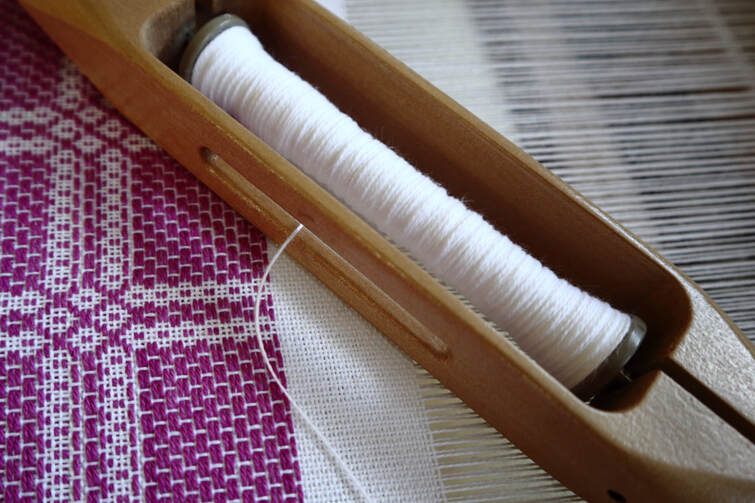
Weavers are some of the most generous and helpful people in the fibre arts community - and given how amazing all yarn people are, that’s saying something! Weavers are happy to give their time and spend hours troubleshooting in return for nothing more than a cuppa tea. My guild is filled with hundreds of kind-hearted individuals who will drop everything to help a fellow guildmate.
Why then, does the thought of lending tools or sharing studio space send so many weavers running for the hills?
If weaving was a personality, it would be ISTP on the Myers Briggs scale. Introverted, Sensing, Thinking, Perceiving = The Craftsman (or for most of my guild, Craftswoman!). If I was choosing labels, I would call this personality The Artizan. More than a craftsperson, a person with tremendous dedication to improving their skill and attention to detail that doesn’t borderline on the obsessed - it has a fast-pass to that border and spends every second week on the far side of it.
Introverted: Weaving is a solitary craft. Yes, we gather together to share and learn, but then we go home, to our studio, alone. Our looms are generally too big to lug to weave-ins. Spinning, knitting, crochet, and most other fibre arts don’t have this demand for solitary time to be able to accomplish the most simple aspects of their craft. I came from a knitting and spinning background, where weekly meetups for tea, yarn, and society, were standard. It took me a long time to understand why weavers are such isolated animals.
And let’s face it, there’s the counting! I mean, counting to four is hard enough, but some of these drafts require us to count to 10, 20, or over 810 for one pattern repeat. This does not make for a kind reaction to destruction. One error can cause hours of frustration. If we are alone, the only person we can get frustrated at is ourself and life is safer that way.
Sensing: in this instance, sensing is all about noticing the details. I suspect every fibre artist is strong in this area. We absorb the world around us through our senses - all of them - and remember the details. It’s one of the reasons why textures and smells are so important to us when buying yarn.
The texture, shape, feel, smell, and occasionally taste (I only have two hands, two feet, and sometimes I need to hold things in my mouth) is important to us.
Weavers generally take this focus to the extreme. Forest - trees. A weaver has to see both in excruciating detail. Each thread needs to be measured to the centimetre (or better yet, the 1/16th of an inch). We need to be intimately equated with how much pressure and friction we can apply to a warp thread - as an individual and as a group. Not to mention, the precise tolerances of our tools. This precision was never needed in knitting - where the biggest problem I had was whether the yarn would make the cables pop or if it would pill if knit into a sweater.
Thinking: The thinking personalty analyzes the pros and cons, and seeks consistency and logic in decision making. Weaving is all about consistency. There are so many right ways to do a weaving technique, but the only real wrong way to do it is to be inconsistent. Weaving naturally attracts people who adore consistency. I suspect from an outside point of view, moving the weaving bench two inches to the left isn’t going to be a big deal. But to a weaver, that is a massive deal as it will change the shape of the cloth. Inconsistency in the placement of the tools means the weaver will change their behaviour to accommodate, which changes the finished fabric.
The cloth reflects the moment. This is known in every historical weaving tradition, from the Cowichan people on the West Coast of Canada to the Irish Linen weavers who wove in dark, stone cottages. SAORI weaving technique embraces this understanding that cloth is like a river. Capture that moment and flow in time, and it can never be repeated. Be it our mood, the humidity, the pinched nerve while sneezing, the placement of the tools - weaving is capturing and trapping the moment as the weft is locked into the warp.
But for most weavers, we strive against this. We seek consistency in our work. We often struggle to keep out the influences of the moment and the person, and this too is part of the Thinking element of this personality type.
Perceiving: The balance to perceiving on the Myers Briggs scale, is ‘judging’. And I wonder how to say this without defaulting to the “not a cat” definition of dog. These are both about how we analyze information. Judging likes to put the information in boxes that gives the information value. This was a good thing, that was a good meal, this crosswalk isn’t pedestrian-friendly.
Perceivers are less about organizing where the information belongs and more about accepting it. A thing happened. I ate a meal. Oh, that car almost hit me, I will be more careful in that crosswalk in future. Often the two styles of processing information assume the other style is the same as them. Conflict happens when Judging style assumes the perceiving style assigns moral meaning to each item. The perceivers can’t imagine that anyone would, or even could, file information into groups like that.
Most weavers I know prefer to take in information rather than spend time sorting it into categories. If something happens, no one has to be to blame. We simply look at the situation and see if there is something we can try to prevent it in the future. If the shuttle drops. That’s what happened. The solution is to try different throwing, or bobbin winding, or beaming techniques until we find the way that works. There is too much to do to waste time categorizing events into judgement boxes.
Interesting. But what’s this got to do with toothbrushes?
You remember the toothbrush? I’m honoured. And surprised anyone made it this far.
Introverted, Sensing, Thinking, Perceiving
As an introverted craft, we are used to working alone. Without help.
Actually, between you and me, most “help” isn’t. It’s not that it’s unwanted, it’s that it usually comes without asking. People assume they are helping, and they don’t stop to ask first.
But if someone was willing to ask first, that would be helpful. The SCA (Society for Creative Anachronism) taught me one important thing above all else - Always be willing to offer help, and Always be able to accept no as an answer. Once you get weaving a while and get to know the community, it’s evident that there is no moral value or judgement assigned to the word “no”). They just didn’t need help at that moment in time. But they might later.
Weavers tools, and by extension the placement of them in the studio, are acquired and perfected over decades. Each tool is chosen because it is a perfect match for the weaver, and for many weavers, that means using irreplaceable antique (more than 100 years old) tools. As the weaver uses the tool, it adapts to their body - like a gold fountain pen nib adapts to the writer - and can be majorly messed up when used by someone with a different slant.
Each tool has associated with memories. This loom belonged to so-and-so who wove the most amazing such-and-such and died at the ripe age of 96. This warping mill was made by this famous maker, and the repairs were done by... I got that shuttle from the fibre festival where so-and-so had a heart attack and was saved by ... These scissors are the only heirloom I have from Strawberry Grandma, my great grandmother, and was given to her as a graduation gift, by her aunt who bought them in Portugal in the 1880s. They are the best darn scissors I’ve ever had, and I don’t want them messed up by cutting paper as they are a pain in the ass to sharpen.
Each tool has many hours invested in choosing, repairing, and maintaining. Each and every tool in a studio is an extension of the weaver’s true self. To borrow a toothbrush is nothing compared to borrowing a weaving tool.
Lending a toothbrush may mean nothing more than having someone use it for a photograph. Or they may brush their teeth with it. They may, out of kindness, clean it under boiling water, melting the bristles. Or they may just use it to clean the toilet. To lend a toothbrush not knowing what will happen to it while absent, nor how long it will stay away, would be folly.
But that’s a rubbish analogy. Weaving tools are nothing like a toothbrush. They are far more sacred.
As a new weaver, it took me a while to learn that lending tools was an issue. So many weavers have more than one of a thing just so they can lend out their extra for people just getting started. But many weavers don’t have the space. Their basement isn’t brimming over with spare weaving tools. They streamline and keep just enough space and tools to fulfil their personal weaving needs. These people are more cautious about lending tools. They tend to set little tests with small things before they are willing to let go of the big things.
What worked for me was to listen to the weaver and repeat back what I understood so that my mentor could understand that I absorbed the information. More importantly, that I was willing to treat their tool as they wanted, not the way I thought it should be treated. Small tests would be made to see how good I was at respecting the weaver and their idiosyncracies. Sometimes I passed, and sometimes I didn’t. The worst times were when I tried to be helpful by repairing something - that wasn’t actually broken!


Not only is it a pivot from tutorials to storytelling, but it's also my first collaboration. A few youtube coconspirators and I decided to make videos about angora fibre in honour of Easter and Spring! The videos will show up here as they are published. I encourage you to check them out - there is some great info about angora from knitters, spinners, and other yarncrafters.
Alas, the only bunnies on the farm are wild and don't hang out much with the humans this time of year, I had to make do with Bunny Substitutes. I hope you enjoy.


-web-ready.jpg)